Certificate in News Literacy
The Certificate in News Literacy program enhances students’ ability to discern between credible information and information disorder through critical examination of how we access, analyze, verify, create and share media messages with an emphasis on news.
Overview


Clickbait. Deepfakes. Disinformation. Bias. Conspiracies. Hoaxes. The media, especially the news media, shapes what people know about their community and the world. Being literate about the information you receive is essential for making good decisions. A healthy democracy needs as many people as possible to engage in the digital world, including citizens, journalists, educators, and other professionals. We should have the concepts and tools to tell the difference between truth and falsehoods.
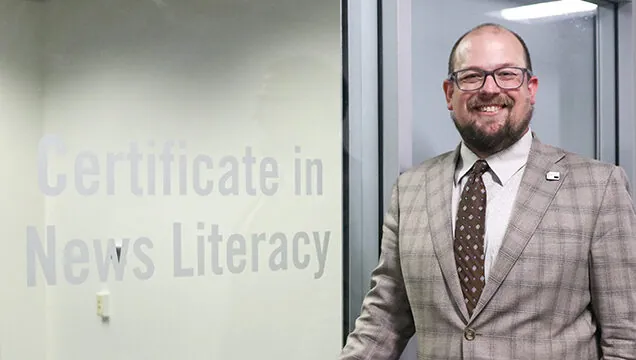
This certificate program enhances students’ ability to discern between credible information and information disorder through critical examination of how we access, analyze, verify, create and share media messages with an emphasis on news. Students study the critical role news organizations play in our marketplace of ideas and will explore journalistic responsibility and important ethical constructs of the news and information ecosystem. This certificate is offered by the James M. Cox Jr. Institute for Journalism Innovation, Management and Leadership.
ELIGIBILITY
The Certificate in News Literacy is open to all undergraduate students enrolled at the University of Georgia.
Students can automatically enroll in the Certificate of News Literacy through their Athena account once registered for the introductory course, JOUR 3030. Students do not need special permission to enroll in the certificate and can enroll at any time.
When you apply in Athena to graduate, you will include the certificate in your application.
CERTIFICATE TRACK: HOW IT WORKS
Students are required to complete four specific courses for 12 academic credit hours. The introductory course must be taken first and the capstone course must be taken last. The intermediate courses can be taken in any order.
JOUR 3030 – Media, News, and Consumers
In this introductory course, students will become critical consumers of media and will explore how media create and disseminate messages, with a focus on current issues in all media forms.
JOUR 5320 – Journalism Ethics and Diversity
The course considers social responsibility and presents a contemporary framework for transparency and community with a focus on diversity as a guiding journalistic principle.
JOUR 5420 – Credibility, the News Media, and Public Trust
This class examines how to sustain credible practice in a time of great change to understand which changes offer the best chance of resolving the conflict in favor of credible practice.
JRLC 3600 – Media Savvy: Becoming Digitally Literate
This capstone course enhances the ability to discern between news and misinformation through critical examination of how we access, analyze, verify, and create media messages. We will look closely at the critical role news organizations play in informing us and its significance for our democracy. This course’s purpose is to be a project-based survey of concepts, techniques, and tools that guide those who are media savvy, such as journalists, to make educated decisions about digital content. NOTE: JRLC 3600E fulfills the requirement during summer semesters.
CLASS Sampler
JOUR 3030 – Media, News, and Consumers
In this introductory course, students will become critical consumers of media and will explore how media create and disseminate messages, with a focus on current issues in all media forms.
JOUR 5320 – Journalism Ethics and Diversity
The course considers social responsibility and presents a contemporary framework for transparency and community with a focus on diversity as a guiding journalistic principle.
JOUR 5420 – Credibility, the News Media, and Public Trust
This class examines how to sustain credible practice in a time of great change to understand which changes offer the best chance of resolving the conflict in favor of credible practice.
JRLC 3600 – Media Savvy: Becoming Digitally Literate
This capstone course enhances the ability to discern between news and misinformation through critical examination of how we access, analyze, verify, and create media messages. We will look closely at the critical role news organizations play in informing us and its significance for our democracy. This course’s purpose is to be a project-based survey of concepts, techniques, and tools that guide those who are media savvy, such as journalists, to make educated decisions about digital content. NOTE: JRLC 3600E fulfills the requirement during summer semesters.
FACULTY
-
Learn More
Amanda Bright
Clinical Associate Professor; Director, Cox Institute Journalism Innovation Lab
ABOUT Amanda Bright, PhD, MJE, is a clinical associate professor specializing in community journalism, news product innovation, design and pedagogy. She is the managing editor of Grady Newsource, assistant editor […]
-
Learn More
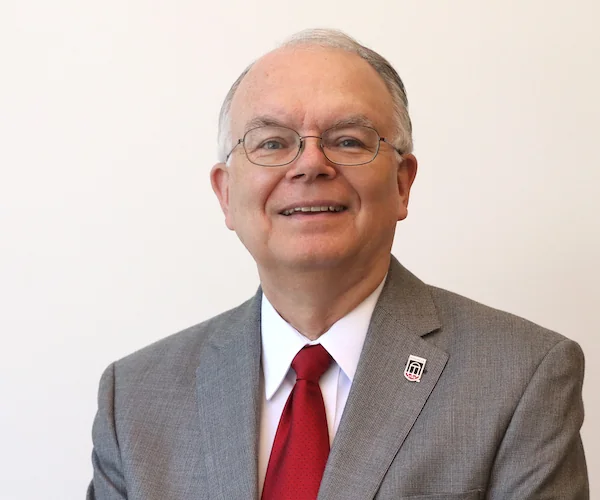
Keith Herndon
William S. Morris Chair in News Strategy and Management; Executive Director, James M. Cox Jr. Institute and Professor of Practice in Journalism
About: Dr. Herndon teaches courses in the Business of News and Financial Journalism along with Food Journalism as a special topics course and as independent study. He also teaches Media […]
-
Learn More
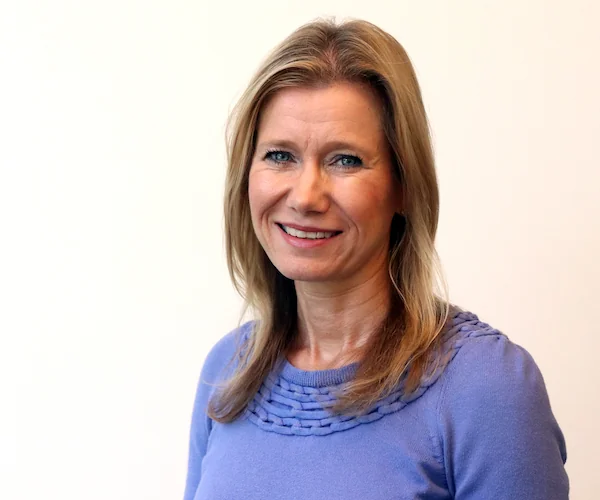
Lori Johnston
Senior Lecturer; Director, Cox Institute Journalism Writing Lab
About: Lori Johnston teaches a variety of journalism classes, including reporting and writing across platforms, religion reporting, home and garden reporting, critical writing, feature writing and investigative reporting. View Curriculum Vitae […]
-
Learn More
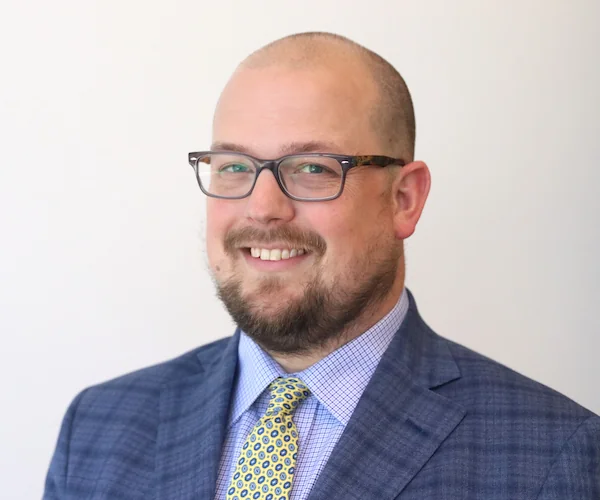
Kyser Lough
Associate Professor; Director, News Literacy Certificate
About: Dr. Lough studies visual communication and solutions journalism, with an emphasis on photojournalism. He teaches graduate-level visual communication method & theory, as well as undergraduate photography and journalism ethics […]
-
Learn More
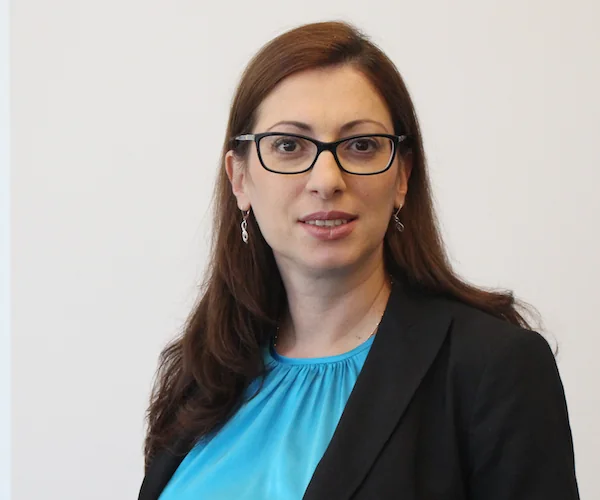
Ivanka Pjesivac
Head, Department of Journalism; Director, James M. Cox Jr. Center for International Mass Communication Training and Research; Associate Professor
About: Dr. Pjesivac teaches undergraduate and graduate courses in digital storytelling, public opinion, and international communication. She studies international and cross-cultural communication, media trust and credibility, and effects of digital […]
-
Learn More
Denetra Walker
Assistant Professor
About Dr. Walker’s teaching specialties focus on how social justice and race issues are covered in journalism. View Curriculum Vitae Education Ph.D., Mass Communication, University of South Carolina M.A., Mass […]

-
Learn More
Andrea Briscoe
Clinical Assistant Professor
About Andrea Briscoe teaches a variety of journalism classes, such as News, Media and Consumers, Introduction to Photojournalism and Entertainment Reporting. She and Dodie Cantrell created Grady College’s first-ever late-night […]
Questions about the Certificate in News Literacy?
Kyser Lough, PhD, Director
Perspectives
“The news literacy certificate amplified the training I received from Grady College. I feel more prepared as I’m beginning my career as a journalist, having the skills to spot in truthfulness in an era of misinformation.”
Ashley Balsavias
(AB ’23)
Perspectives
“As journalists, we have the crucial responsibility and duty of separating the truths from the falsehoods to keep the public informed. The News Literacy Certificate equipped me with the skills and knowledge to do just that.”
Sydney Hood
(AB ’23)
Apply
Students can automatically enroll in the Certificate of News Literacy through their Athena account once registered for the introductory course, JOUR 3030. Students do not need special permission to enroll in the certificate and can enroll at any time.
The Latest
Read the newest headlines, get updates and discover events happening at Grady.
Shira Chess authors book about evolution of internet and belief systems
An examination of the rise of the internet and its connection to belief systems is the subject of “The Unseen Internet,” a new media studies book by Shira Chess, associate […]
Profiles of Tenacity: Anna Kapustay
Anna Kapustay is a Double Dawg Master’s student in Integrated Advertising and Public Relations with minors in communication studies and business from Rome, Georgia. Set to graduate in May 2026, […]
Jessica Maddox named editor-in-chief of new Creator and Influencer Studies journal
Jessica Maddox (BA ’12, MA ’15, PhD ’18), associate professor in the Grady College Department of Entertainment and Media Studies, has been named the inaugural editor-in-chief of the new, fully […]
Bulldog 100 Profile: Robin Burnett (ABJ ’99, BSFCS ’00)
This is one of a series of interviews honoring Grady College alumni who have been recognized as Bulldog 100 recipients in 2026. The Bulldog 100 is sponsored by the UGA […]
Bulldog 100 Profile: Catherine Denham (ABJ ’05)
This is one of a series of interviews honoring Grady College alumni who have been recognized as Bulldog 100 recipients in 2026. The Bulldog 100 is sponsored by the UGA Alumni Association […]
Deborah Norville honored with DiGamma Kappa’s Distinguished Lifetime Achievement Award
University of Georgia alumna Deborah Norville (ABJ ’79) was given the 2026 DiGamma Kappa Award for Distinguished Lifetime Achievement in Broadcasting and Cable on Jan. 30, 2026. The national student […]