

Yarbrough Distinguished Lecture Series: Simon Paterson
Yarbrough Distinguished Lecture Series: Simon Paterson
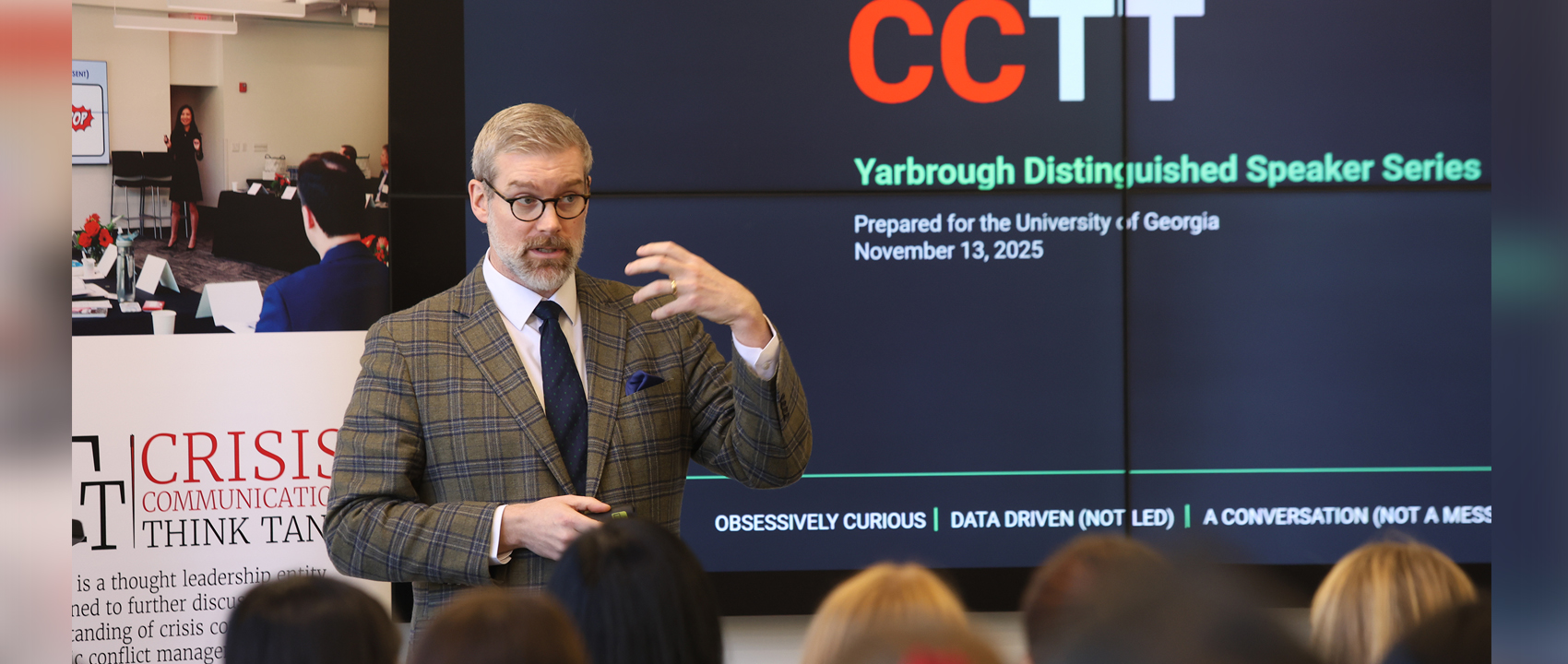
Simon Paterson, MBE, misinformation and disinformation management expert, delivered the third Annual Yarbrough Distinguished Lecture on Crisis Communication Leadership, 2025, titled “Decoding the Adversarial Information Ecosystem: Challenges and Responses.” The lecture, hosted by UGA Crisis Communication Think Tank (CCTT), was held at Grady College of Journalism and Mass Communication on Nov. 13, 2025.
During his lecture, Paterson emphasized the three main keystones of leadership success and career fulfillment: “Be obsessively curious, data-driven (not led) and have a conversation (not a message).” These themes carried throughout the session as Paterson emphasized that societal shifts and digital disruptions, including greater acceptance of disinformation and widespread feelings of frustration and marginalization, are reshaping how information is created, shared and consumed.
“Crisis and disinformation management is not something you can toggle on and off. It’s a long-term game, you have to build that trust,” said Paterson.

Paterson stressed the importance of proactive risk management. For firms to adapt and stay ahead, rather than mitigating crises as they arise, they should establish proof points to combat potential weak points that could be exposed. As he elaborated, just knowing your audience is not enough in the current information space; you must know your environment and know who influences your audience on multiple levels.
Paterson further warned that, as the number of malicious bots increases and the bots themselves become more sophisticated, it is getting increasingly more difficult to decide which narratives have been skewed and what to believe.
When asked whether educating the public on misinformation versus disinformation is a worthwhile expenditure of resources, Paterson replied, “Do they need to be told what is false? No, make a better case for what is true.”
Throughout the day, Paterson took time to meet and exchange insights with Yarbrough Fellows, Crisis Insights & Analytics Lab scholars, Crisis, Risk, and Disaster Communication Certificate Program graduate students, and crisis communication undergraduate students. He also met with faculty from Grady College, Terry College of Business and the School of Law. They discussed topics ranging from the integration of promotion and protection in strategic leadership and how GenAI and data technology are disrupting our global information systems, to the imperative of new ways of thinking and action-taking in the arena of information governance and crisis management.
During these discussion sessions, Paterson reflected that oftentimes, as a crisis communication practitioner, you are “part crisis communications expert and part executive therapist.” He emphasized that effective crisis management requires an expert, not emotional, response. Encouraging senior executives to sometimes consider taking a step back rather than engaging directly with a conflict, such as a heated public discussion in a social space without knowing the source and motive behind it, can help minimize the damage of a crisis on the enterprise.
The Yarbrough Distinguished Lecture Series, supported by the CCTT, is inspired by and grounded in the thought leadership of Richard C. Yarbrough (ABJ ‘59).
“[I] thank Simon Paterson for sharing his considerable expertise,” Yarbrough noted in his remarks shared with Yan Jin, Yarbrough Professor in Crisis Communication Leadership, highlighting “the importance of the communications discipline being at the ‘head table’ in crises… and developing a next generation of effective and respected communicators which will get them there.”
Author: Grace Carter, goc00165@uga.edu