

Ph.D. Profile — Brittany Shivers
Ph.D. Profile — Brittany Shivers
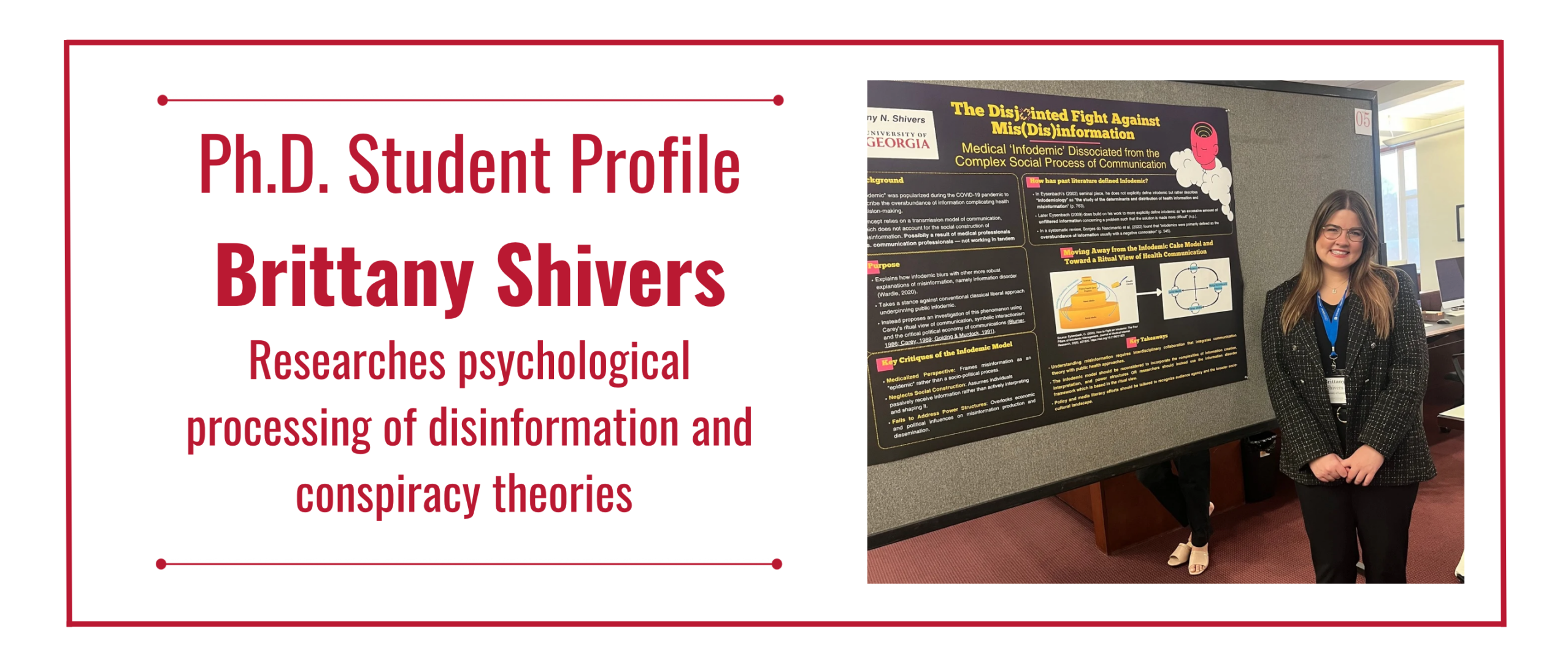
Brittany Shivers (MA ’23) is a third-year Ph.D. candidate whose research examines the psychological processing of disinformation and conspiracy theories and the ways social media exacerbates information disorder.
She investigates how organizations, teams and individuals can adopt a “readiness” mindset to tackle the information disorder crisis, including ways to combat disinformation spread through artificial intelligence.
Shivers currently teaches Reporting I: Critical Skills for Reporting and Storytelling. She conducts research as a part of the Digital Media and Cognition (DMAC) Lab and the Crisis Insights and Analytics (CIA) Lab teams.
Before pursuing her Ph.D., Shivers graduated from the University of West Georgia, where she served as the editor-in-chief of the university’s newspaper, The West Georgian. She also completed an internship at The Newnan Times-Herald, freelance work for The Times-Georgian, and served as the Senior Editor of Special Publications for The Red & Black.
The following is an interview with Shivers.
What made you decide to pursue your Ph.D.?
When I was in undergrad, I started as a psychology major and I went to a small private Christian College. I played volleyball there, and then I transferred to the University of West Georgia, because that’s where I’m from. Not a lot of people go to UGA or big colleges where I’m from, so I was in a very rural town. I didn’t really know much what I was doing, but I knew I loved writing. So, I switched from being a psychology major to journalism. I was the editor in chief of the school newspaper, and I knew I loved doing this stuff, but there wasn’t a long-term career path.
My undergrad professor was the person who handled the newspaper and my undergraduate institution, and I guess he saw something in me. He told me I need to go to grad school, so I applied to my master’s at UGA at the last minute and got accepted.
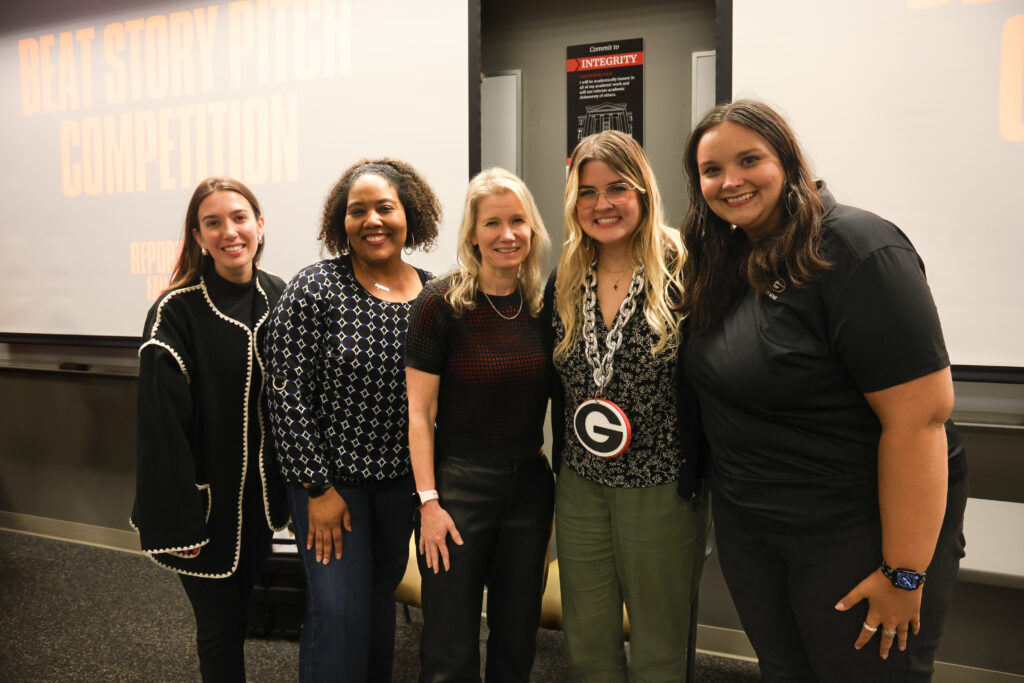
One day, Dr. Nate Evans met with me after class. I was the only master’s student, and at some point, he called my name down the hall. He asked if I had thought about getting my Ph.D., I said I thought about it, but I wasn’t sure. He said he seriously thought I should consider it. I think I needed someone to believe in me, to take that step. I had mentors who saw something in me, and I knew this was what I needed to do. Every day, I wake up, and I see the university, and I pass by Sanford and think, “I am so grateful to be here, it’s a blessing for me to be here.”
(Photo/Sarah E. Freeman)
Please provide a brief explanation of your dissertation topic and why it’s important to you.
I’m doing my dissertation topic on cancer misinformation. There are a lot of fake “miracle cancer cures” on social media. This misinformation is so harmful because people can forego conventional cancer treatment for miracle cancer cures, which can cost them their lives. Things like fenbendazole and ivermectin are anti-parasitic drugs that people are taking instead of doing it along with their conventional treatment. Ivermectin can cause toxicity, seizures, fatigue, all those things.
There’s a lot of medical mistrust right now that has become politicized. I go to social media because that’s where people are getting their information. People aren’t reading; they are just scrolling their phone getting entertainment, and in the middle of that, they’re also getting misinformation. These influencers are profiting off human vulnerability; it’s really disgusting. I’m really in the media psych space, combining my two loves. I ask, “How do people perceive AI-assisted information versus stuff that was fully made by humans? Which do they trust more? Do people trust public health influencers more, or doctors?”
I work in cultural cognition theory, and the misinformation interventions need to be curated based on cultural values. This is my driving factor. Because I’m from a rural area, I am invested in learning how people’s brains work depending on their cultural values and geography. I want to know, for rural versus urban Americans, how we can reach those people who have high levels of medical mistrust.
What other projects (research, teaching or otherwise) have you been involved with as a doctoral student and candidate?
(Photo/Sarah E. Freeman)
I do crisis communication work in the lab with Dr. Yan Jin. I’ve been the lead author on a lot of the readiness framework that we’ve been doing. This is more than crisis communication organizational research. How can organizations be ready for a crisis? It goes beyond preparedness; preparedness is skills training and making sure your organization has resources and plans. Being “ready” transcends this preparedness idea. Right now, we’re trying to develop a scale measure for it. Our research in the Crisis Communication Think Tank and the Crisis Insights and Analytics Lab is about bridging academia and industry together, tying into my interest in real-world impact.
I also do eye-tracking research in the DMAC lab with Dr. Bart Wojdynski. We were working with Socio-Technical Solutions for Countering AI-Generated Deepfakes. It was an interdisciplinary seed grant from UGA. One of my favorite things that we were doing was trying to see if people could tell the difference between AI-generated and non-AI-generated images.
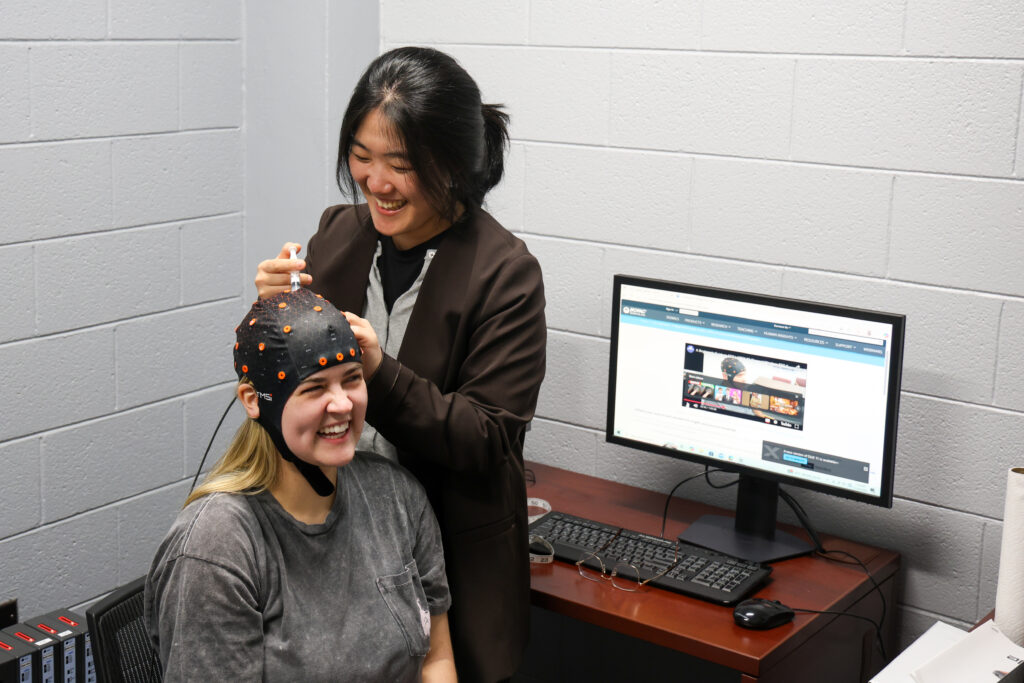
I also started doing an independent study with Dr. Glenna Read and the Brain Body Media Lab, working with EEG and brain electrodes. My long-term research trajectory for when I’m a professor at Clemson in the fall is getting into EEG and still doing more eye-tracking research.
What has been the highlight of your doctoral education?
The project all the way back from my first quantitative research methods class with Dr. Evans, the one I presented, and he told me I should apply to the Ph.D. program, ended up becoming my master’s thesis also on misinformation interventions on TikTok. After I finished my thesis, I submitted it to AEJMC, and Dr. Wojdynski and I won. We submitted it for awards in the faculty division and won the first-place faculty paper award. I just loved working with Dr. Wojdynski; he’s going to be my lifelong mentor. I’m now building on that study for my dissertation, which I didn’t plan to do, but I’m just interested in that space, and that’s my favorite paper that I’ve done. I’ve presented that paper in the media-savvy class at least twice. Students love it because it’s kind of media literacy-esque and TikTok research.
What is a fun fact about yourself, your research field or other related fields?
I’m going to be starting at Clemson in the fall as an assistant professor and it’s my dream job. I’m so excited. It was always my goal to work at a research institution and teach students. The coolest part about that job is that I’ll be the director of Tiger Student Media. They have a radio station, TV station, newspaper and two magazines. I’m going to be the director over all of that. My teaching load is a little less because I have that director role, so I can manage all my things. I am still expected to publish two research articles a year, which is typical for an R1 institution like Clemson. I’m going to be moving there this summer and getting started.
What advice would you offer to someone considering a Ph.D. program?
You really must have a love of learning. You must have this internal passion, not external. You should not get a Ph.D. if you just think other people would be impressed by you getting it. It’s a nice perk to say I have a Ph.D., but that’s not my one driving factor. My driving factor is that I love learning. I love school. I’m a curious person who wants to know answers to things. If that is your core drive, then you will be successful. You need that drive because it is hard, and you will not get through if you don’t have that tenacity.
If you are already getting your Ph.D., the most important thing is to choose your dissertation chair wisely. They make or break the whole Ph.D. A lot of people choose their advisor based on their research interest, which is good. You should have common research interests with the person, but you should be able to work well with that person as a human being. Collaborations are important. Some people try to do their research agenda on their own, and you can do that, but that’s not for me. I have to do team-based science and that makes it more fun.
Editor: Sam Tupper, Samuel.tupper@uga.edu