

Michael Cacciatore awarded $2.5 million grant for research
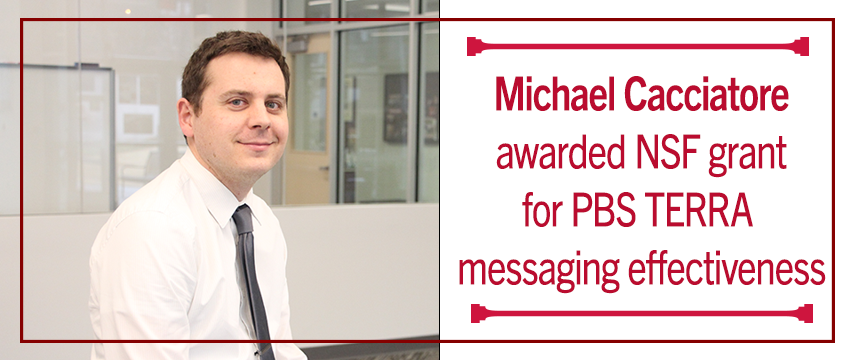
Michael Cacciatore awarded $2.5 million grant for research
Funds from the U.S. National Science Foundation support research for PBS TERRA, a science-themed hub on YouTube
Michael Cacciatore, co-director of the Center for Health and Risk Communication at Grady College, has been awarded a $2.5 million grant from the U.S. National Science Foundation’s Advancing Informal STEM Learning program.
The funds will provide research for PBS Digital Studios’ TERRA, its science-themed hub on YouTube, as they launch a new slate of STEM content.
Dr. Cacciatore is a co-principal investigator for the grant that also includes Dr. Sara Yeo of the University of Utah.
The grant from NSF will support a two-pronged PBS initiative to create STEM-related, short-form videos and conduct follow-up research to better understand how and why these videos attract underrepresented groups.
“Dr. Cacciatore’s work exemplifies the very best in collaborative research on issues of great importance,” said Charles N. Davis, dean of Grady College. “It’s a reminder that all grant-funded research contains a communicative element, and that Grady College faculty can help design and implement rock-solid empirical studies of message design and effectiveness.”
Cacciatore explains that PBS not only wants to expand its audience with new and underserved audiences, but the organization also recognizes the importance of bringing research into decisions so they are informed by data. He expects part of the research to focus on the role of humor in communicating science, an area PBS already utilizes and that Cacciatore studies.
“For me, this project builds naturally from a lot of the work I’m already doing on humor as a tool for science engagement,” Cacciatore, an associate professor in the Department of Advertising and Public Relations, said of the three-year grant. “At the same time, this project places more of an emphasis on the practical side of things. We’ll have a chance to collect data, analyze the underlying trends in that data, and then see our work influence the content PBS is producing.”
Cacciatore is excited to work with content producers like PBS.
“From an institutional perspective, I love the idea of PBS, arguably the most important provider of educational programming, partnering with UGA, the birthplace of higher education. I think it’s a perfect marriage,” Cacciatore said.
Currently, YouTube’s most popular STEM creators are disproportionately white and male, and viewer data and PBS surveys suggest that Black and Hispanic viewers, as well as women overall, are underrepresented in audiences for STEM content online. With support from the NSF grant, PBS Digital Studios aims to remedy this by expanding PBS TERRA to new, diverse audiences, and examining its impact.
Specifically, PBS Digital Studios plans to launch new series and create special episodes for existing series that explore STEM through a variety of lenses, including humor and popular culture. These STEM series will feature underrepresented voices, especially Black and Hispanic science communicators, in front of and behind the camera and seeks to broaden the audience for STEM content online.
“With the help of NSF, we hope to inspire the next generation of scientists by offering diverse and educational programming in a new way. At PBS, we are committed to presenting viewers with topical content that they cannot find anywhere else— and PBS TERRA is a perfect example. This is incredibly important work, and we are excited to innovate with STEM content and study the impact this content has within underrepresented communities,” said Sylvia Bugg, Chief Programming Executive and General Manager, General Audience Programming at PBS.
The research will be used to show how these groups search for and engage with content related to science, technology, engineering and math. Cacciatore and Yeo will also test hypotheses on the effects of STEM videos featuring scientists and experts that are women, Black and/or Hispanic presenting science content in a variety of ways. A goal of the project is to measure audiences’ attitudes and engagement with science as well as their perceptions of scientists.
The NSF’s AISL program seeks to advance new approaches to and evidence-based understanding of the design and development of STEM learning opportunities for the public in informal environments; provide multiple pathways for broadening access to and engagement in STEM learning experiences; advance innovative research on and assessment of STEM learning in informal environments; and engage the public of all ages in learning STEM in informal environments.