

UGA GRAIL initiative launches to advance crisis and risk research

UGA GRAIL initiative launches to advance crisis and risk research
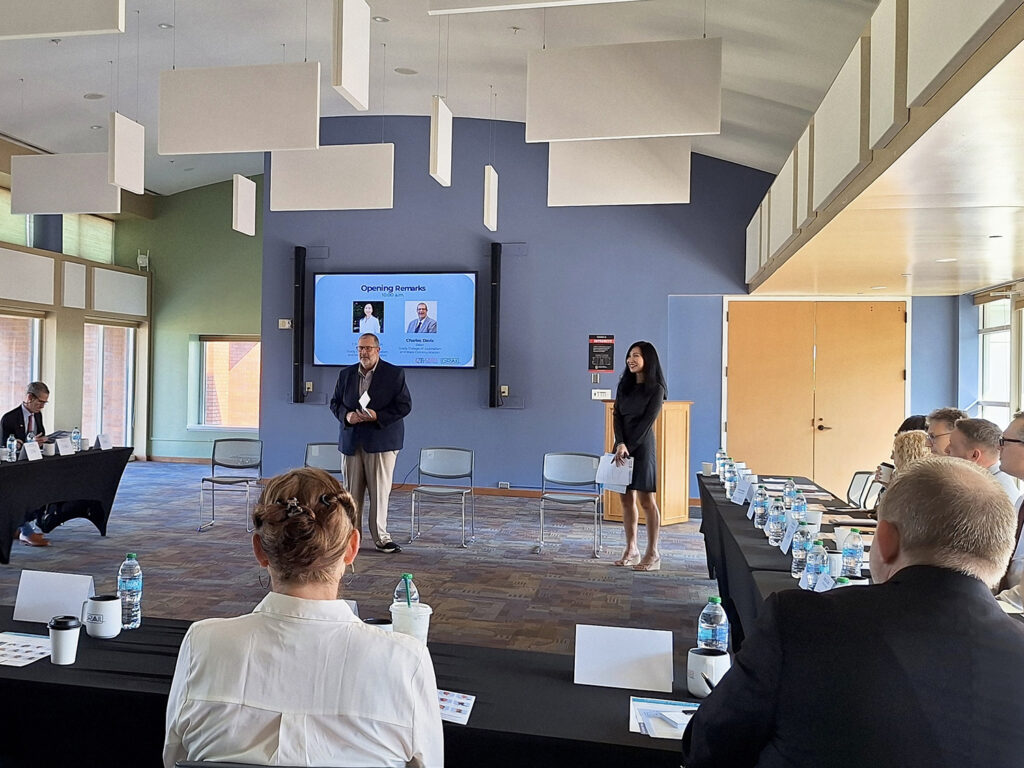
On April 24, 2026, the Crisis Communication Think Tank (CCTT) hosted the inaugural launch program for “Leading with GRAIL: Strategic Crisis and Risk Management Innovation for Health, Security, and Resilience” at the University of Georgia School of Law. The event brought together scholars, practitioners and students from across fields to formally launch the new interdisciplinary initiative designed to advance crisis and risk management research and leadership development.
GRAIL – an acronym for Governance, Readiness, Alignment, Integrity and Legitimacy – is a theory-driven research framework developed to help organizations anticipate, prepare for, and lead through complex risks and crises. Supported by a 2025 UGA Teaming for Interdisciplinary Research Pre-Seed grant, the initiative brings together the CCTT, Grady College of Journalism and Mass Communication, Terry College of Business and the School of Law to advance research collaboration and strategic innovation addressing risks and crisis issues essential to health, security and resilience.
Throughout the day, attendees engaged in five in-depth sessions, each exploring one dimension of the GRAIL framework through panels featuring leading voices from academia and professional practice in the fields of strategic communication, law and business management. Grady College Dean Charles Davis and CCTT director Yan Jin provided opening remarks for the launch program before leading into the sessions. Matt Auer, Dean of the School of Public and International Affairs, also shared leadership insights on the importance of interdisciplinary, academia-industry collaboration and how the CCTT-led GRAIL initiative can make an impact on business and policy alike.
Governance – Policies, Processes and Systems in Crisis and Risk Management
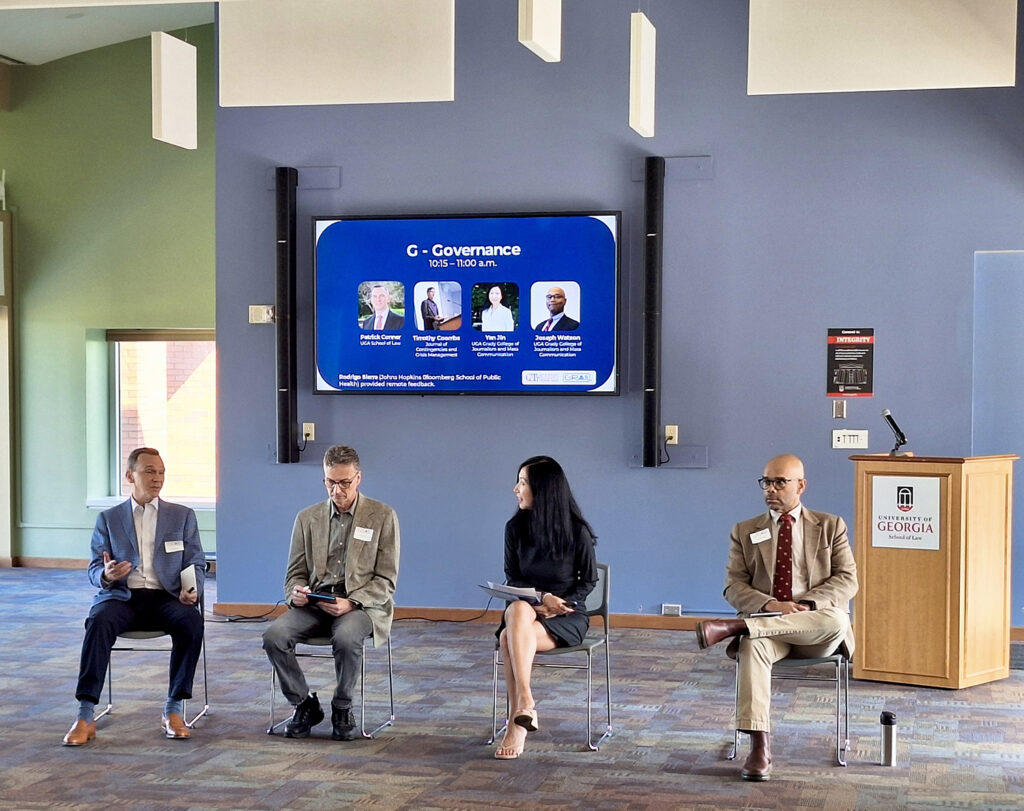
In the first session of the day, panelists Patrick Conner (School of Law), Timothy Coombs (Journal of Contingencies and Crisis Management), Yan Jin and Joseph Watson (Grady College), with pre-gathered input from CCTT practitioner member Rodrigo Sierra, examined the role of governance in crisis management. They distinguished “big G” governance (an organization’s broader strategic and structural character) from “little g” governance (the day-to-day processes, procedures and controls that enable an organization to function effectively), arguing that both must be present and aligned for an organization to manage crises effectively.
The panel debated “strategic silence” at length, concluding that the response strategy can work when grounded in pre-existing stakeholder strategy. However, organizations cannot make significant pivots, such as going from years of engagement on an issue to sudden silence, without credibility costs. The session closed on the importance of building stakeholder relationships before crises occur, since organizations cannot reliably assess the expectations of different stakeholder groups during a crisis.
Readiness – Building Multi-Team Efficacy with a Readiness Mindset
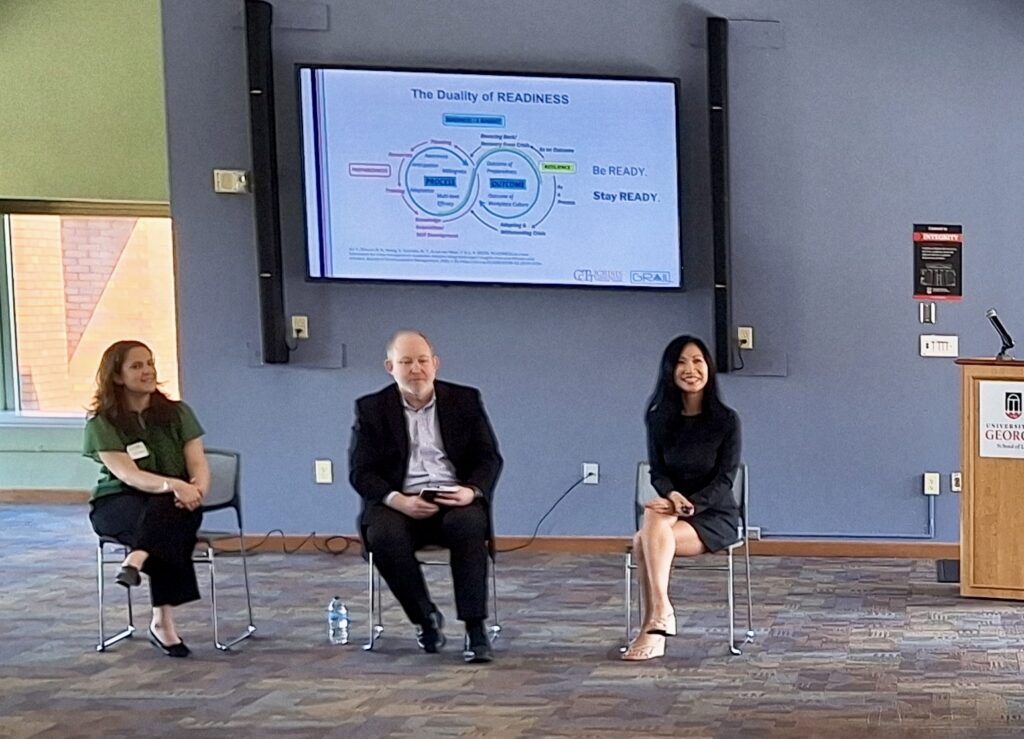
The second session featured panelists Jason Epstein (Terry College) and Yan Jin, with previously shared insights from Rodrigo Sierra and Nadeem Kasmani (Harvard Medical School). The panelists opened by making a sharp distinction between preparedness – having plans and training in place – and READINESS™ – the mindset and agility to execute when unexpected events occur. The panelists argued that organizations tend to invest heavily in preparedness while neglecting readiness.
The discussion also highlighted the importance of accounting for reputational and communication risks, preparing for not only high-severity scenarios but also day-to-day vulnerabilities, and exploring ways to address organizational silos that lead to a lack of the cross-functional relationships within an organization needed for a coherent crisis response. The panel emphasized that the goal of readiness is not to anticipate every possible crisis but to build the collective devices and confidence that allow organizations to adapt intelligently to unexpected situations.
Alignment – Cross-Learning, Training and Integrating Internal-External Strategy
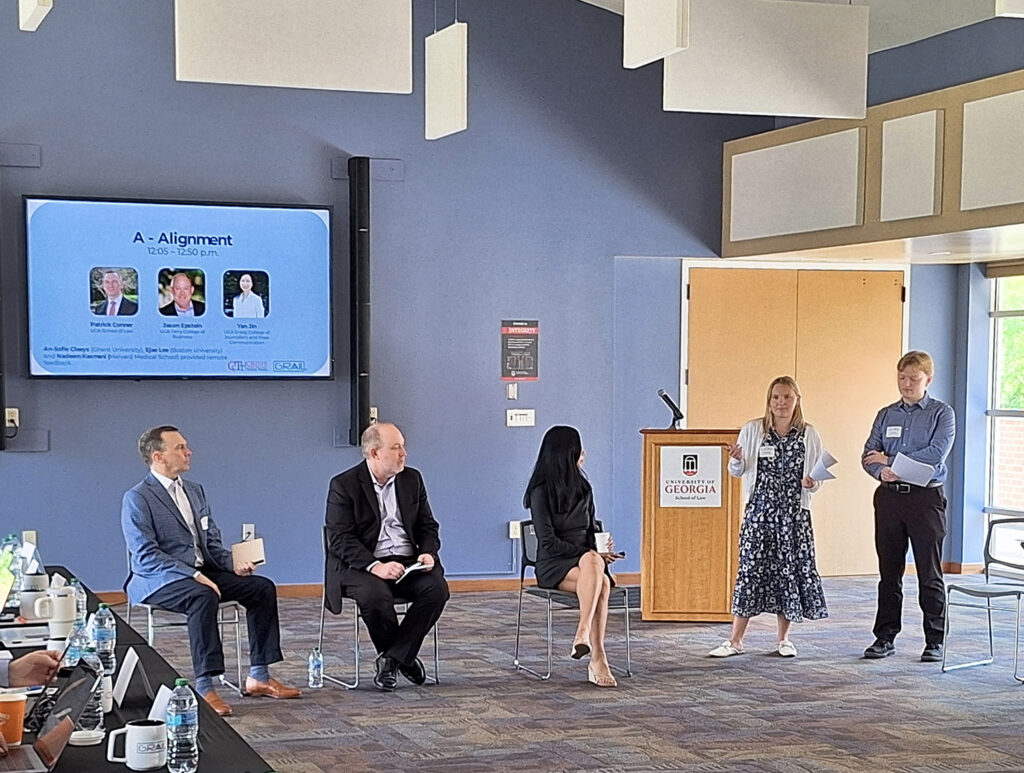
Patrick Conner, Jason Epstein and Yan Jin led the Alignment panel with previously shared input from An-Sofie Claeys (Ghent University, Belgium), Ejae Lee (Boston University) and Nadeem Kasmani. The panelists explored how alignment simultaneously operates across multiple levels, such as mission and values, cross-functional team coordination and individual employee understanding. They emphasized the importance of developing alignment before a crisis occurs, as misalignment that exists in normal operations cannot be corrected under the pressure of a crisis situation.
Internal communications emerged as both a powerful tool for building alignment and an underappreciated risk, given the frequency with which such communications can be leaked to the public. The panel concluded that strong alignment requires investment in relationships, not only processes, and that organizational incentive structures must actively reinforce an organization’s stated values.
Integrity – Ethics, Public Trust and Multi-Stakeholder Management
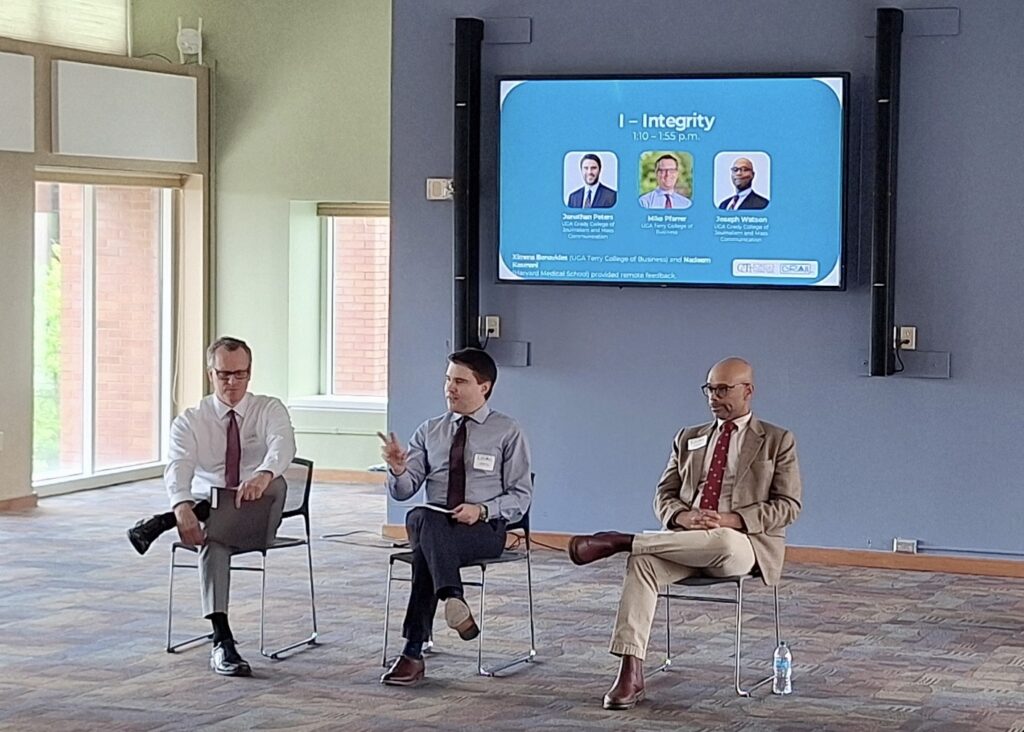
The Integrity panel was led by Mike Pfarrer (Terry College), Jonathan Peters (Grady College) and Joseph Watson, with insights shared by Ximena Benavides (Terry College) and Nadeem Kasmani prior to the event. The panel drew a critical distinction between competence crises (operational failures) and integrity crises (failures with a moral dimension ascribed to them), the latter being far harder to manage due to the ethical judgments stakeholders apply to them.
Panelists noted that an organization’s reputation can act as both a buffer against criticism and a burden due to the higher standards stakeholders will have for the organization. The panel also emphasized consistency as the most critical expression of integrity, particularly in a polarized media environment with fewer traditional gatekeepers.
Legitimacy – Reputation, Stakeholder Confidence and Organizational Performance
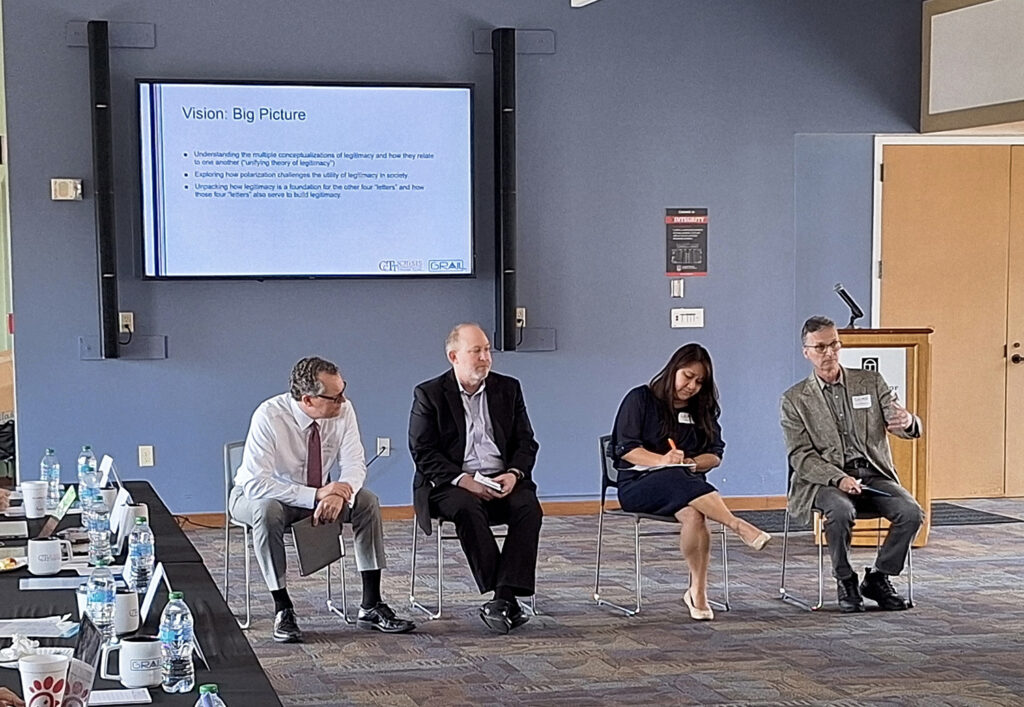
The final session of the day, Legitimacy, was led by Mike Pfarrer, Jason Epstein, Holly Overton (Arthur W. Page Center for Integrity in Public Communication at Penn State) and Timothy Coombs, with pre-gathered input from An-Sofie Claeys. The panel recognized the changing landscape of legitimacy in a fragmented, polarized media environment. The operative question surrounding legitimacy has shifted from whether an organization is legitimate or not, to which stakeholders consider it legitimate and on what terms.
The group distinguished legitimacy from legal compliance; while complying with the law involves following formal rules, legitimacy more closely relates to conforming to the social norms and expectations that an organization’s stakeholders value. The panel also considered how these social norms shift over time as society evolves. What is considered legitimate behavior for one generation may not be for another, meaning organizations must not only understand where stakeholder expectations currently stand but also track where they are heading. The session closed with a discussion of how generative AI may reshape the legitimacy landscape as the public increasingly searches for a shared sense of truth.
The launch program closed with the inaugural GRAIL coalition looking forward to advancing knowledge generation and transfer across research, training and practice. The goal of this new interdisciplinary and cross-institutional effort for strategic research development is to devise effective shields that protect health, security and societal resilience, equipping the next generation of leaders with new frameworks and strategic tools, navigating an increasingly complex information and issue landscape with confidence and readiness.
Author: Mason Brock (mab55372@uga.edu)