
Charles Davis receives Weltner Award from Georgia First Amendment Foundation
Charles Davis receives Weltner Award from Georgia First Amendment Foundation
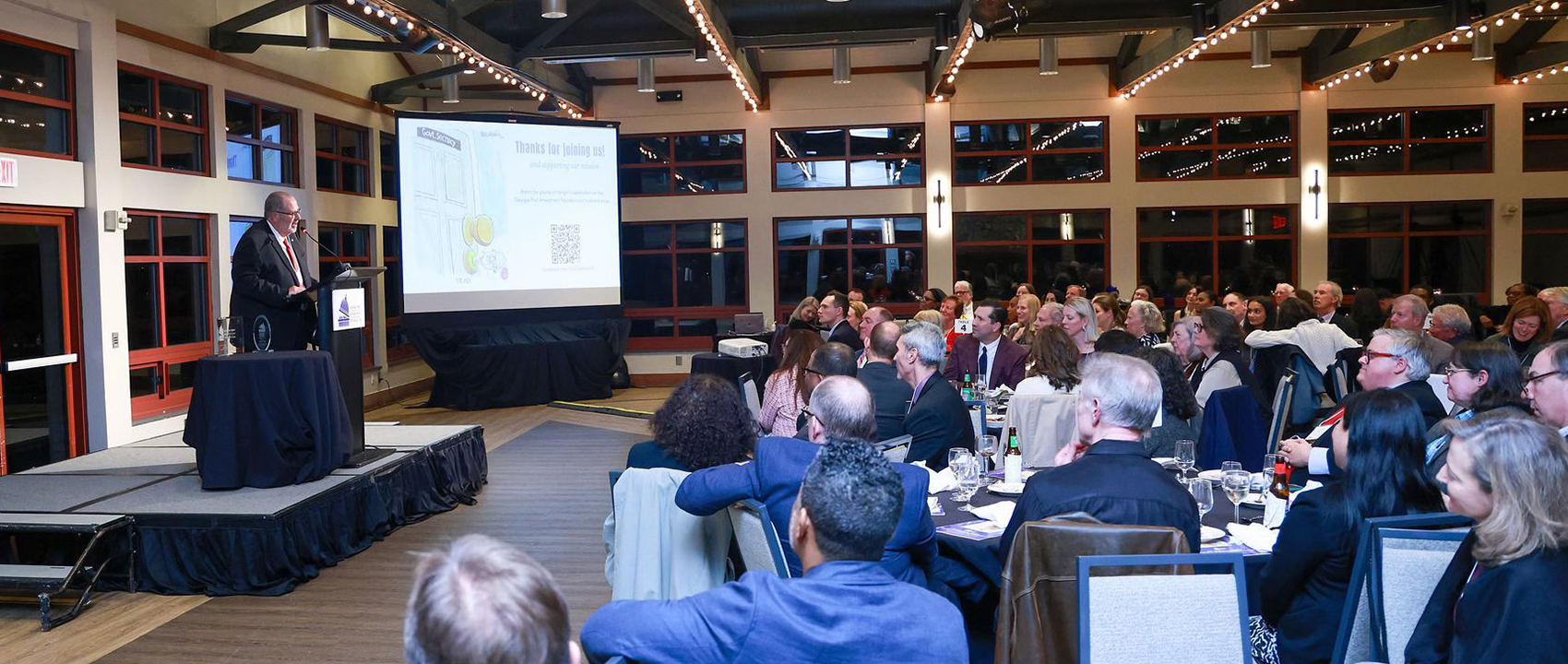
Charles Davis (MA ’92), dean of Grady College and a journalism scholar in press freedoms and the First Amendment, received the 2025 Charles L. Weltner Freedom of Information Award from the Georgia First Amendment Foundation (GFAF) in a ceremony on Oct. 28, 2025.
The award honors a person or group whose work has significantly improved freedom of information in Georgia. The award is named after Weltner, a former Georgia Supreme Court Chief and member of the U.S. House of Representatives.
“The Weltner Award is a singular honor, and I’m truly humbled by the Foundation’s selection,” Davis said. “I have worked in open government circles just about all of my professional life, so it’s a full circle moment for sure. What a great organization, and what important work they do.”

Jonathan Peters, associate dean of academic affairs at Grady College, introduced Davis at the awards.
“By every measure, Charles is a champion of transparency and of journalism’s role in our democracy,” said Peters, who was a doctoral student of Davis at the University of Missouri before working together at Grady College. “We’re fortunate that Charles has dedicated his energies not only to scholarship and institutional leadership but also to the practical, challenging work of helping people, in their daily lives, act on the principles and promise of free expression and information access.”
Davis has been a scholar of the First Amendment for more than 30 years, when he earned his master’s degree from the University of Georgia and wrote his master’s thesis about the history of the Georgia Open Records Act. Davis shared his interest in the subject with the Georgia First Amendment Foundation upon receiving news of the award.
“That’s what began my academic fixation with how and why governments can keep some things from the people, and not others,” Davis said. “That power — the power to declare a document secret — animated my research and continues to fascinate me. People undervalue openness and transparency, buzzwords that are easy to say and much harder to operationalize.”

In addition to his prolific writing and teaching on the subject, Davis served as executive director of the National Freedom of Information Coalition from 2005 to 2010 and as executive director of the Freedom of Information Center from 2000 to 2005. He has written widely on the subject, including co-authoring two books, “Access Denied: Freedom of Information in the Information Age,” which he co-wrote with Sigman L. Splichal in 2001 and “The Art of Access: Practical Strategies for Acquiring Public Records,” which he co-authored with David Cuillier in 2010.
“As an educator, Charles hasn’t simply taught the theoretical,” Peters said. “He has trained a generation of journalists in Georgia and beyond to carry the mission forward to strengthen our collective right to know. I can say that with certainty because I’m one of them.”
Richard Griffiths, a retired vice president and senior editorial director at CNN and chairman of the Grady College Board of Trust, was also recognized at the ceremony as the recipient of the Founder’s Award. Griffiths serves as a GFAF board member.
View a video recognizing Davis’s contribution to freedom of speech here.
Author: Sarah Freeman, freemans@uga.edu