

The Oglethorpe Echo class recognized by Google News Initiative for solving problems in community journalism
The Oglethorpe Echo class recognized by Google News Initiative for solving problems in community journalism
Grady College journalism students and faculty were represented on the international stage in November when the JournalismAI Innovation Challenge project they worked on was featured in a documentary. The program was supported by the Google News Initiative.
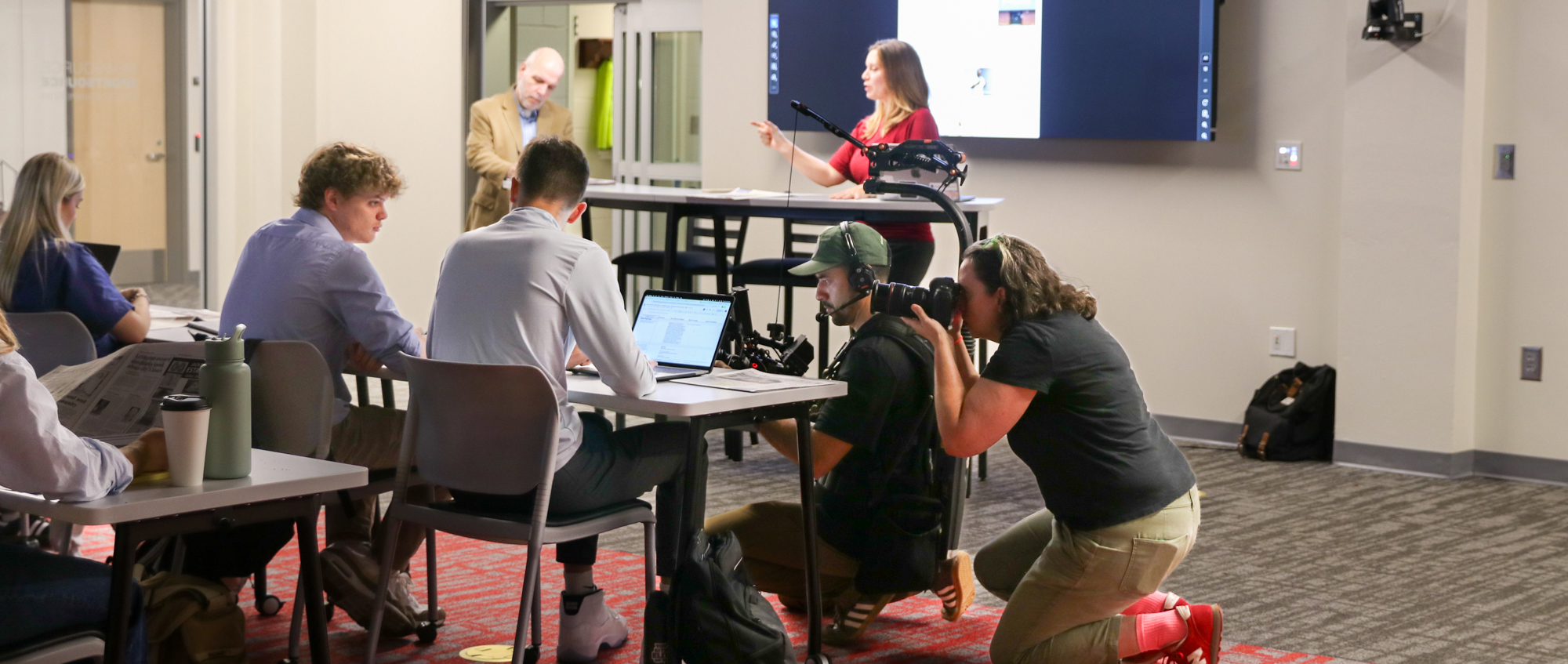
The short film premiered at the JournalismAI Festival in London and featured Amanda Bright, clinical associate professor and director of the Cox Institute Journalism Innovation Lab, and several students involved with The Oglethorpe Echo capstone class.
“The documentary was amazing,” Bright said. She added that it was a highlight for the students because they were involved with a project that an international audience was watching.
The documentary, which was produced by Google with a 16-person crew, focused on the development of an AI app called YESEO that Bright and the students worked on with Ryan Restivo, the app creator. The Oglethorpe Echo was one of only five U.S. newsrooms to receive this grant. And, it was the first to beta test an expansion of YESEO, which writes headlines and social media content and suggests follow-up stories based on news features that were already written. Bright and Restivo later expanded the tool even more, so that reporters could learn quickly about the people, places and issues of Oglethorpe County.
The AI beta project was made possible by a $50,000 grant from Google, which Bright said she applied for on a lark.
“I think we were selected because we represented small rural newsrooms and a news academic partnership that allowed us to play with AI in a different context than a lot of the other applicants,” Bright says.
The reason the app is important to newspapers like The Oglethorpe Echo is that community newspapers are frequently looking for more ethical and effective workflow efficiencies to tell stories and ways to expand into digital media.
Despite the fact they were testing and making recommendations for this AI tool, Bright says that the editors and students adhere to a rigorous ethics standard when it comes to using AI in news coverage. The key policy is that all their material is vetted and verified through a series of human editors.
“I think we intentionally made the tool not capable of doing the things that we feel are unethical at this point with AI,” Bright says.
Bright admits that every news organization in the world is negotiating how to use AI right now, and this tool was never developed to write full journalism features.
“We have a policy for The Echo that nothing created by AI directly reaches the audience without human intervention,” Bright says. “This tool was built to create newsroom efficiencies, so that students would still be doing all the reporting and all the things that humans do well: building relationships, making observations and finding stories. But, this tool helps us speed up some of the more laborious aspects, or things that we just wanted to do more quickly so we could spend more time out in the field reporting.”
Bright admits that some weeks the new AI tool was used a lot and sometimes it wasn’t used at all. She also said that despite the fact that the AI tool they tested and provided input for was based on Slack, they are hopeful it will be developed for other platforms in the future and that Grady Newsource will soon be using it.
The academic partnership between Grady College and The Oglethorpe Echo is unique, educating journalism capstone students to write, edit and produce issues of the community newspaper every week under the direction of journalism professors and editors. Since the collaboration was created between Grady College and The Oglethorpe Echo Legacy Inc. non-profit in November 2021, the newspaper has grown to include an online and social media presence, as well.
Author: Sarah E. Freeman