

Grady Research Radio: How we understand and interpret AI-generated content, with Dr. Bartosz Wojdynski
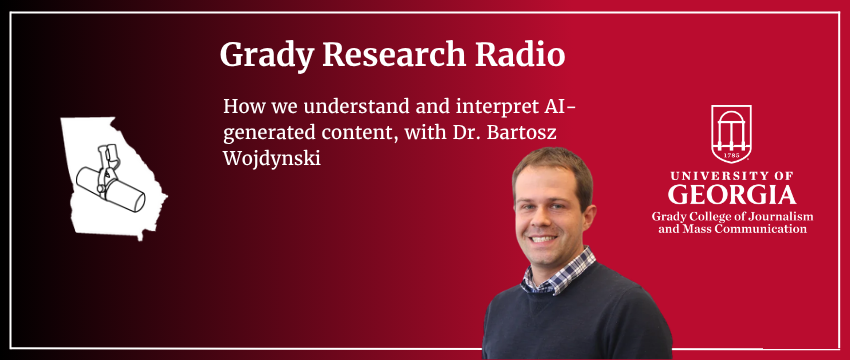
Grady Research Radio: How we understand and interpret AI-generated content, with Dr. Bartosz Wojdynski
Bartosz “Bart” Wojdynski, a Jim Kennedy New Media professor and director of the Digital Media Attention and Cognition (DMAC) Lab at Grady College, shared insights into his academic journey and research during an interview with Grady Research Radio.
Wojdynski’s academic path was unique, beginning with an English degree that proved invaluable for grant writing and allowed him to hone his multimedia content creation skills. This experience, combined with conducting experiments to test usability, was eye opening as to how to create accessible digital products. It also sparked his interest in human subject research, leading him to pursue a Ph.D. in Mass Communication at the University of North Carolina at Chapel Hill. After graduation, he taught at Virginia Tech for two years before joining Grady College in 2013.
“I realized that a lot of the questions I wanted to answer as a researcher were about what happens while people are consuming digital media,” Wojdynski says. “Being able to see where people are looking and for how long…what they miss and what they notice…was a big part of that.”
Wojdynski’s passion for understanding how people consume digital media led to the establishment of the DMAC Lab, which is known for its eye-tracking technology using cameras and infrared projectors to record a user’s gaze point. These cameras record at about sixty times per second to understand the subject’s comprehension of digital media.
A key focus of Wojdynski’s research is AI-generated content and deep fakes. Wojdynski is a member of an interdisciplinary grant team funded by the President’s Office that is developing a Chrome plug-in to inform users about the origin of images, specifically where the images come from and the chain of custody. The research aims to understand how people interpret this information, if they understand what it means and if they care about it. The project is in partnership with computer scientists and the UGA School of Law.
He cautions that advice on detecting AI-generated content is highly dependent on rapidly evolving technology.
“Any list of shortcuts I give to people is probably going to be outdated within eighteen months,” Wojdynski says.
Wojdynski also applies his lab’s findings in the classroom. In his deep fake seminar, he plans to incorporate recent studies on assessing the authenticity of video clips. For his digital design course, students use AI tools to generate new versions of their work, learning to make it better than what AI generates. He also enjoys teaching the Data Gathering and Visualization course.
Editor’s Note: This feature was written with the assistance of AI and edited by a human.
Grady Research Radio Interview: Riley McLaughlin, Riley.McLaughlin@uga.edu
Editor: Sarah Freeman, freemans@uga.edu