Fellowship Profile: Alan Griggs (ABJ ’72)
Fellowship Profile: Alan Griggs (ABJ ’72)
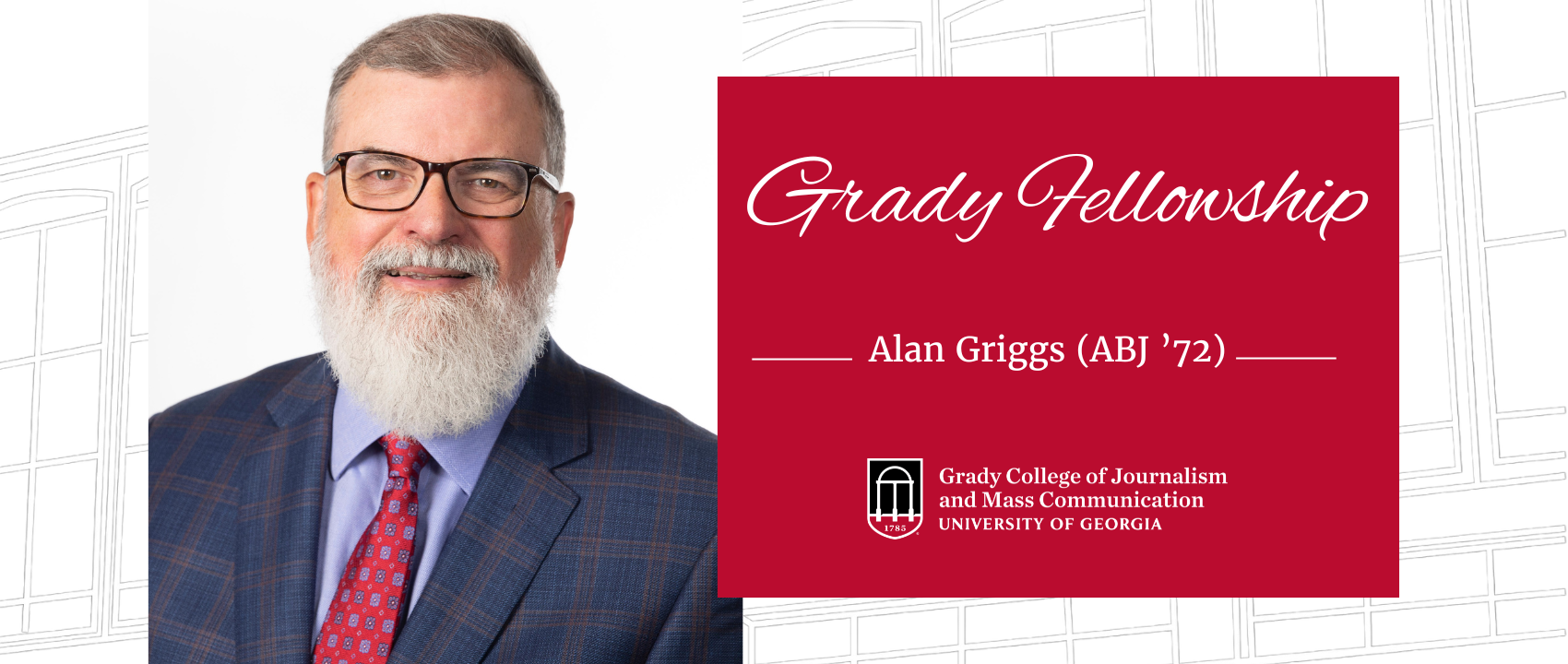
Alan Griggs is a senior manager of communications with diverse experience including television news reporting and management; political, corporate and crisis communications; and teaching.
He is currently associate professor in the School of Communication at Lipscomb University, and he has served in similar roles at Tennessee State University, the University of Tennessee and Western Kentucky University.
Griggs spent nearly 20 years at WSMV-TV in Nashville, first as a reporter and working his way up to news director, a position he held for nine years. His television career also includes political assignment work for NBC News and work at WBZ-TV in Boston, where he was an investigative reporter and manager of its investigative unit. Griggs has received numerous awards throughout his career including three Peabody Awards, a duPont-Columbia citation for a documentary on the Ku Klux Klan and an Edward R. Murrow award for broadcast excellence, among others.
In 1994, Mr. Griggs served as the communications director of a U.S. Senate campaign. He later became a marketing director for Film House, Incorporated, handling strategic positioning and marketing for television stations around the country. In July, 1995, Griggs was named director of media strategy for United Methodist Communications, an agency of the worldwide United Methodist Church. He was a reporter and producer for the PBS program “The Wild Side” and a senior consultant with the Institute for Crisis Management, helping organizations worldwide handle business crises.
Griggs is the author of two books: “Flying Flak Alley: Personal Accounts of World War II Bomber Crew Combat” and “The Life and Tales of Pony Maples, Jr.”
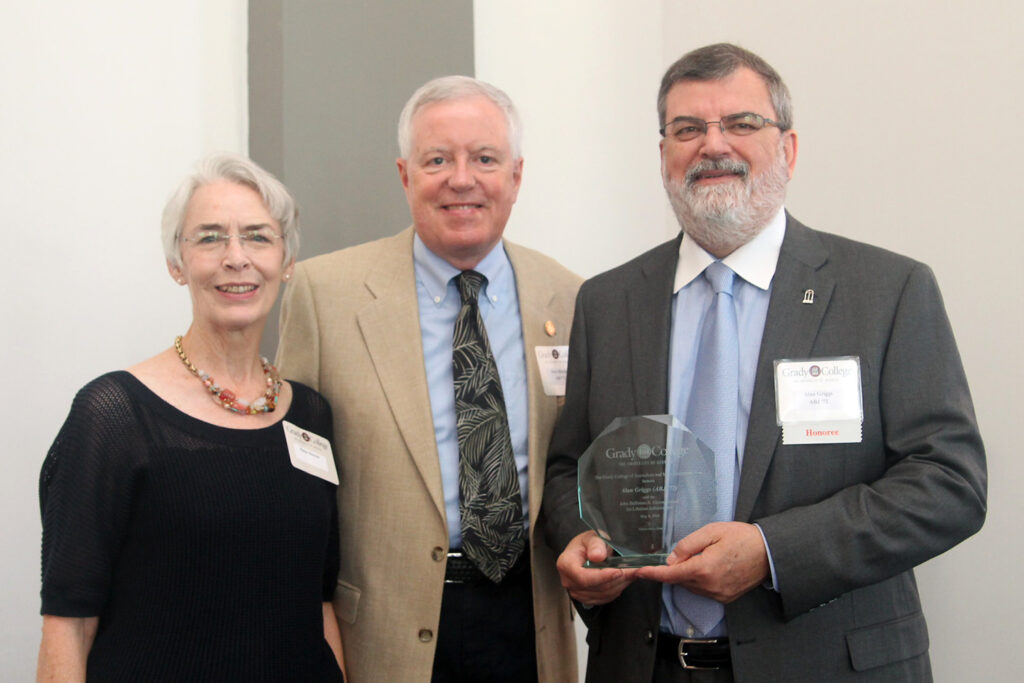
He was the John Holliman Jr. Lifetime Achievement Award honoree by Grady College in 2014, prior to the time that honorees of this award were automatically inducted into the Fellowship.
Following are excerpts from an interview with Griggs.
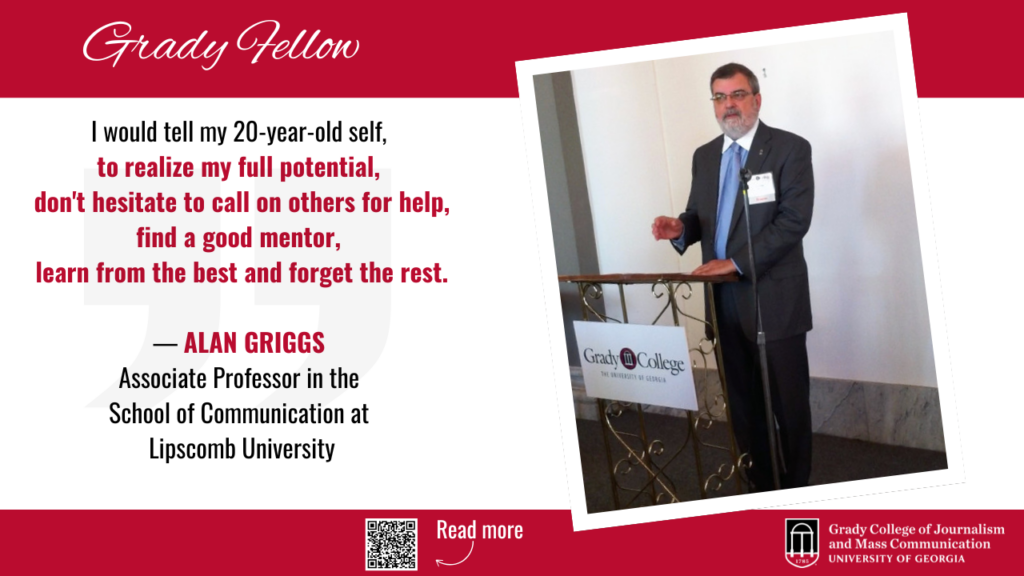
What would you tell your 20-year-old self?
I would tell a younger version of myself exactly what I told myself back then: gain experience, work hard and dedicate myself to be the best journalist I can be. Realize my full potential, don’t hesitate to call on others for help, find a good mentor, learn from the best and forget the rest. If this sounds like an ideal I suppose it is because I set the bar pretty high for myself while still a student at Grady and carried that with me into the real world. I remember being one of the few students in the Journalism program to actually have a full time job waiting for me before graduation. I was very fortunate.
What experience at Grady College did the most to prepare you for the industry?
I should give vast credit to my primary journalism professor, Bill Martin, for his encouragement and leadership during my time at Grady. He was exacting with his feedback and that was exactly what I needed. I, along with the other students, received tons of valuable hands-on experience in the TV studio and out in the field, all of which contributed to making my job preparation the best that it could be. In fact, my boss at WAPI-TV told me that I had been hired based on that preparation and on my work in radio during my time in college.
What are the most important skills communicators should master?
Effective and efficient storytelling, I believe best served with a touch of humor, and a consistent desire to base their work pointing toward the true north of fact and truths. Even opinion and commentary should be fact-based, and again most effective when arguments are made with civility and with a smile.
What advice do you have for today’s students?
Keep everything in perspective. Realize that journalism, along with other communications fields, has always been a dynamic industry. The fact that it is even more so today can be placed squarely on the rapid advances in technology. But remember that when I started in TV news we were using big, clunky film cameras. During my time in the business, we moved from those cameras to videotape cameras which got smaller and much more manageable over the years to today’s chip cameras with their ability to go live from almost anywhere. The advances in technology have been dizzying at times but manageable and helpful. Most importantly, remember that the world will always need good communications practitioners, no matter the format. The public wants and needs to be informed. The demand will be there. The question remains the evolving format. Digitization is with us and will remain with us. The challenge is not to lower our standards of thoroughness and fairness in telling the stories people need to see and hear.
What motivates you?
The awareness that there are many, many important stories that need to be told — and, by so doing, to keep the powerful accountable, to give voice to the voiceless and allowing a better-informed public to make the world a better place. Those have been my ideals since the first day I became a full time journalist.
If you had college to do over again, what would you do differently?
I would be more proactive in creating a broader-based education for myself. While I had a split minor in history and speech, a do-over for me might mean that I would minor in sociology or psychology or maybe business or economics or marketing. I believe I was a little too focused on my major to not give enough time to other courses which would have made me more of a well-rounded person. I ended up taking exactly one business course at UGA. Now, with hindsight, I know I needed more of a variety of courses to prepare me for reporting on a variety of subjects.
What does this recognition mean to me?
I consider the Holliman Lifetime Achievement Award and the honor of being a Grady Fellow to rank equally with the three Peabody Awards I have received. That should tell you about the level of esteem I hold for Grady College and for the University of Georgia. Being a Grady Fellow is a fitting end to my career as a journalist and as a communications professor. I am honored and humbled…and I truly mean that.
The 2026 Fellowship Inductees will be recognized along with the 2026 Alumni Award recipients during the annual Grady Salutes event. This year’s Grady Salutes will be a luncheon on Friday, March 27. Visit the Grady Salutes webpage for reservations.
Editor: Sarah Freeman, freemans@uga.edu