

Cox Institute hosts media literacy influencer Kelsey Russell for News Literacy Certificate Fall 2025 Celebration
Cox Institute hosts media literacy influencer Kelsey Russell for News Literacy Certificate Fall 2025 Celebration
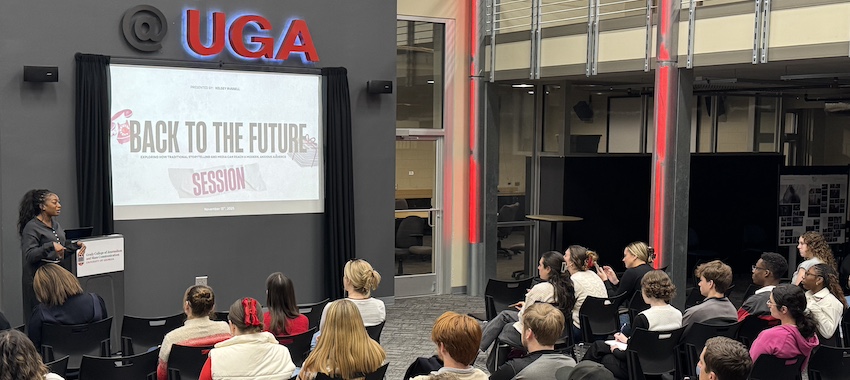
University of Georgia students collaborated with their peers and heard from media literacy influencer Kelsey Russell at the News Literacy Certificate Fall 2025 Celebration.
The event highlights the accomplishments of certificate graduates while welcoming new students to the program. Russell served as the keynote speaker, sharing her career wisdom and industry insights with attendees.
Using print media as a vehicle for promoting curiosity, Russell works to improve media literacy and better emotional regulation when engaging with the news. She has more than 100,000 followers on her TikTok, where she reads different newspapers and magazines to her audience.
Encouraging curiosity and nostalgia, Russell works to help generations of people love learning once more. Russell is the co-host of First Stop News, a news show for tweens and up with new episodes every week on YouTube and quick breakdowns on TikTok. She is also the host of the Kronikled podcast, “where media literacy gets a mic.”

Kyser Lough, director of the Cox Institute’s Certificate in News Literacy, facilitated the event. The certificate hones students’ skills in discerning credible information and information disorder through critical examination of how people access, analyze, verify, create and share media messages — with an emphasis on news. The certificate is open to all UGA students, and currently has more than 180 students enrolled across 31 majors.
Hear below from students who attended the event on their experience.

Shea Edwards
Sophomore public relations and political science double major
Russell is known for her TikTok videos in which she reads print newspapers. She described her journey to that path, which was originally based on anxiety and lack of confidence while in a college class due to not being well-informed about current events. That insecurity led her to subscribe to The New York Times.
“I’m an extrovert; I love to chat,” Russell said. ”For the first time in a class, I did not feel confident raising my hand and speaking, and it was because so many of my classmates knew what was going on in the policy world, like whatever is (on) the front page of whatever news you subscribe to. It felt like when they came to class, they knew everything, and I didn’t, and I was hesitant to share, hesitant to ask questions.”
Madison Hawthorne
Junior journalism major
Russell said print newspapers allowed her to read more intentionally instead of scrolling through news on her phone. She said this made her recognize how algorithms were created by the information she searched for and how she reacted to it.
“I realized I was reading the same stories I saw on my social media, but I was engaging with them very differently,” Russell said. “Taking time to read physical stories helped me feel more in control of what I was consuming.”
Keely Heffelfinger
Sophomore journalism major
Russell said her TikTok videos focus on analyzing print news stories, a contrast to the typical content that a viewer sees on their feed. She illustrated how a typical scroll can bury significant news under unrelated and overwhelming content and said that those fast-paced feeds often strip viewers of control.
“My scroll goes from skincare to a terrible geopolitical issue to how to make dinner,” Russell said. “I don’t know how much agency I had over my news consumption before (reading print).”
Demi Kurtz
Sophomore journalism and fashion merchandising double major
“What makes old media feel less overwhelming?” Russell asked, prompting reflections on staples of the early 2000s like Scholastic Book Fairs, BrainPOP and American Girl magazine.
Russell guided students through group exercises that challenged them to reinvent familiar forms of old media into new experiences with which today’s consumers could actively engage. The activities encouraged students to reimagine how nostalgic media can evolve into less overwhelming, more accessible formats while still preserving their original charm.
Hollis Turner
Sophomore journalism major
Russell highlighted the recent rise of newsletters on Substack, the return of film photography and the popularity of apps like Partiful, which she said attempt to recreate the personal, tangible feel of traditional invitations. These examples demonstrated how older media formats are still present in today’s digital space. She encouraged students to consider why these nostalgic forms feel comforting compared with fast-paced digital feeds.
“I would argue that before I started reading more physical print, I don’t know how much agency I had over my news consumption,” Russell said. “If I tell my phone that I love pasta, it’s gonna show me a bunch of pasta. If I tell my phone I hate vegetables, when it finally shows me vegetables, it’s gonna be in this very negative, emotional, reactive way.”
Meghan Pascual
Sophomore journalism major
Russell said that unlike many influencers, she credits journalists in all of her posts.
“I share three- to seven-minute TikTok videos. I annotate what I read, I share, I storytell, I talk about the source,” she said.
Today, Russell said it’s important to be able to integrate media forms from the past that make us happy. She cited an example of a “magazine reading” event that takes place at a library near her house in New York.
“You come by from anything from five minutes to the entire four hours, and you just read magazines with your friends, you talk, you listen to music,” she said.
Author: Alexis Derickson, alexis.derickson@uga.edu