

Financial advice for students and young professionals
Financial advice for students and young professionals
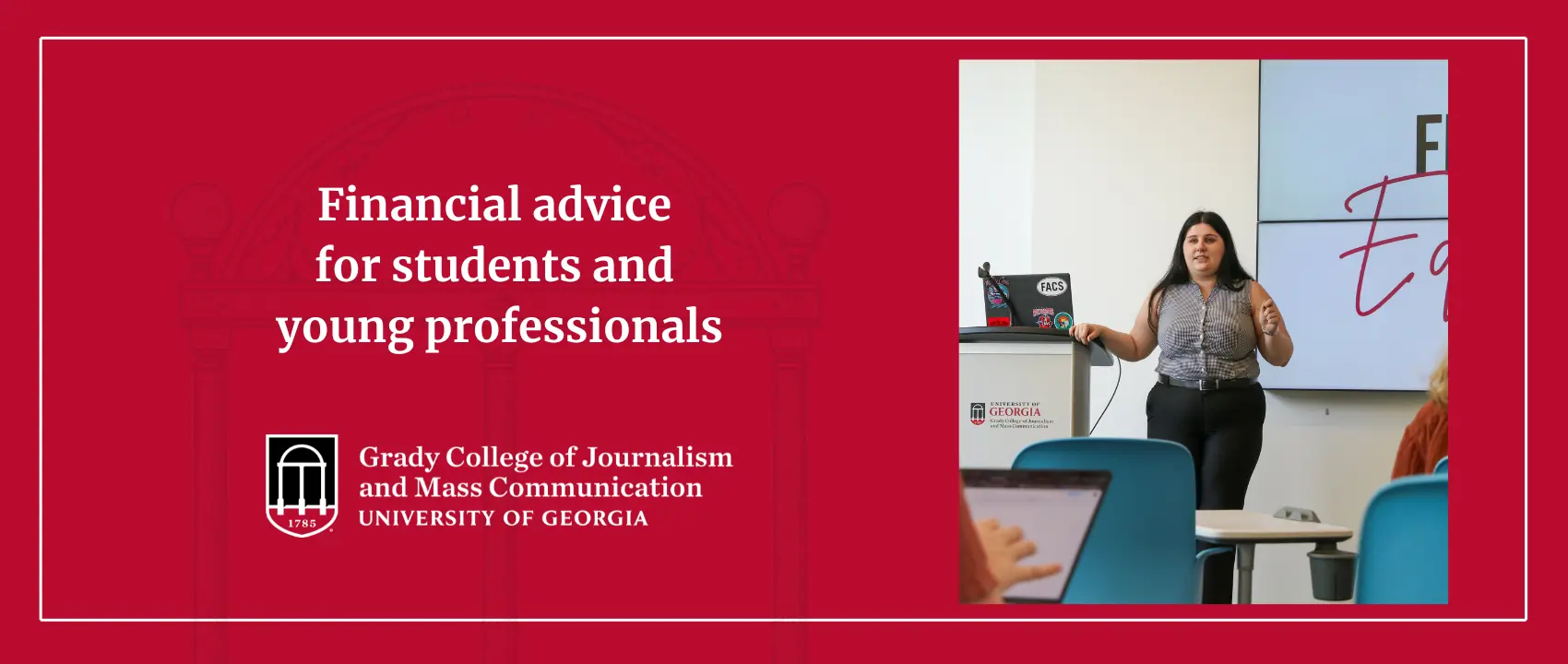
Navigating personal finance can be a daunting task without help. Sarah Hilton, a behavioral financial planning graduate student from the College of Family and Consumer Sciences, spoke to Grady students on April 13 in the Peyton Anderson Forum, offering a beginner’s guide to building good planning habits.
Budgeting
Budgeting is the process of creating a plan to spend money. The plan helps ensure you have enough money for what “matters most while preventing overspending,” Hilton said. Budgets provide a path toward financial goals and ensure you have enough savings for future needs.
To begin budgeting, Hilton recommends people identify sources of income (salary, investments, side projects) and track their expenses.
Next, she suggests categorizing spending such as two types of fixed expenses (rent/mortgage, insurance, debt payments): variable (groceries, dining out, hobbies) and discretionary (entertainment, shopping, travel).
Two of the most common budgeting tactics Hilton recommended are the 50/30/20 and the zero-based budget plans.
The 50/30/20 plan suggests putting 50% of income toward necessities like groceries, housing, utilities, transportation or minimum loan or credit card payments. The 30% of income goes to wants like dining out, gifts, travel or entertainment. The remaining 20% goes to savings or debt pay down, like minimum payment for loans or credit card debt, or deposited into a savings account.
The zero-based budget, in comparison, suggests accounting for every dollar in your budget. The idea is to find your income and expenses every month, categorize those expenses (rent, utilities, groceries, clothing, eating out) and allocate every dollar into one of these groups.
“This is different from living paycheck to paycheck in the way that you’re not only spending on needs, but you’re also categorizing all of your spending,” Hilton said.
Credit

A credit score is a calculated number that rates your creditworthiness, which is part of how banks, landlords or certain jobs determine whether to work with you or not.
“Having a good credit score helps you get approval and lower interest rates for loans, can qualify you for better credit cards and helps you when applying to rent,” Hilton said.
The number is determined by payment history, the amount of credit owed, length of credit history, types of credit and new credit. A credit score from 670 to 850, the maximum, is considered good to excellent, while 300 to 669 is poor to fair.
“If you have a better credit score, you might get offered a higher credit limit on your card, or you might have less fees,” Hilton said.
Credit scores can be improved by consistently paying bills on time, using less credit and avoiding applying for a lot of credit at once. Hilton said this is a “hard inquiry” that can lower credit scores.
Most credit debts fall off your score in seven years, unless you are actively paying them.
While many people may be tempted to close old credit cards, Hilton advises against it. It is more beneficial to have a credit card in the long term.
“If you’re carrying a zero balance on a card and you don’t have to pay a fee, keep it open,” Hilton said. “I know it’s annoying, but if it’s a card you’ve had since you were 16 and you have to open another one at 40, you’re erasing a lot of credit history, which will decrease your score.”
Savings
Savings, Hilton said, are a great way to be prepared for unexpected expenses, help achieve financial goals and build wealth security over time. She recommends saving about 20% of income, putting into an emergency fund with about three to six months of expenses or 15% of pre-tax income towards retirement.
The types of savings include short-term savings for about one to three years, like vacations or new vehicles; long-term savings for over three years, for goals like house payments or retirement; and emergency funds set aside for unexpected financial needs, like medical bills or car repairs.
Another component of building financial security is understanding interest. Compounding interest is interest earned on both your original amount and the interest you accumulate over time, which is great for savings, but bad for debt. The initial period is when you first deposit the money, and you earn interest on that original amount.
For the subsequent periods, you earn interest on the original amount plus the interest you earned so far. The cycle repeats every period, leading to exponential growth over time. The higher the interest rate, the faster your savings grow.
Hilton mentioned three types of savings accounts: high-yield savings, money market and employer-sponsored retirement savings accounts. High-yield savings accounts offer higher interest rates than traditional savings accounts, earning more interest on savings and are Federal Deposit Insurance Corporation (FDIC) secured, meaning your money is safer.
Money market accounts can offer higher interest rates than regular savings accounts, are FDIC-insured and include a debit card. Hilton said, however, that they “used to be higher rates,” but have been more similar to regular savings accounts, and the quick access to money could “encourage spending.”
Finally, employer-sponsored retirement savings accounts work by automatically putting a portion of each paycheck into a retirement account to invest. The account holder can decide how much of the paycheck to put into the account, but the employer may match the contribution up to a certain amount or percentage.
“If your salary is $35,000, if you contribute $1,050, which is 3%, they will match it and also contribute $1,050,” Hilton said.
Investing
Investing involves putting money into a stock or bond you believe will appreciate over time. Stocks are investments in a small piece of a company’s earnings and assets called “shares.” Companies sell these shares of stock to raise cash. These stocks can offer high returns but also carry a high risk of loss for investors.
Bonds, on the other hand, are loans you make to a company or the government that they will repay with interest. Hilton explained that they are generally less risky than stocks but may have lower returns.

Through her experience providing financial counseling, she believes investors should take several steps to prepare. Investors must understand their goals, how willing they are to risk losing money to get a higher return and how large their emergency fund is before they begin.
Hilton also warns beginner investors about several common mistakes. A lack of diversifying the stocks you invest in can lead to a higher risk of losing money.
“Different investments respond differently to market conditions,” she said, “which balances potential gains and losses if you diversify.”
Emotional investing involves making decisions based on fear, like selling when the market is down or greedily chasing trends, which can hurt long-term investments. Neglecting to do proper research into these trends or any investment can also lead to poor outcomes.
Finally, Hilton believes that having a longer-term strategy tends to outperform market timing.
“No one can predict every single factor that goes into the stock market,” Hilton said. “Trying to perfectly time a buy or sell is likely not going to happen. It’s usually a better strategy to find things that you believe are going to do well and that you believe in and invest in those.”
Resources
Lastly, Hilton mentioned the resources available to students interested in financial planning, including the Love and Money Center, a service provided by the College of Family and Consumer Sciences. The LMC is a training center for both the Couple and Family Therapy Program and the Financial Planning program.
The LMC offers discounted services and serves as a training center for student therapists and counselors, overseen by the faculty there.
The Couple and Family therapy program is a reduced-cost way for the center’s therapy students to help couples and families with a variety of concerns, such as communication issues, conflict, divorce, financial stress and more.
The LMC also offers individual therapy sessions for those struggling with financial anxieties and free financial planning to help people with their financial questions and to help them feel more empowered about managing money, Hilton said. They can assist with improving financial behaviors, best budgeting practices and other money concerns.
Author: Sam Tupper, Samuel.tupper@uga.edu