

Shira Chess authors book about evolution of internet and belief systems
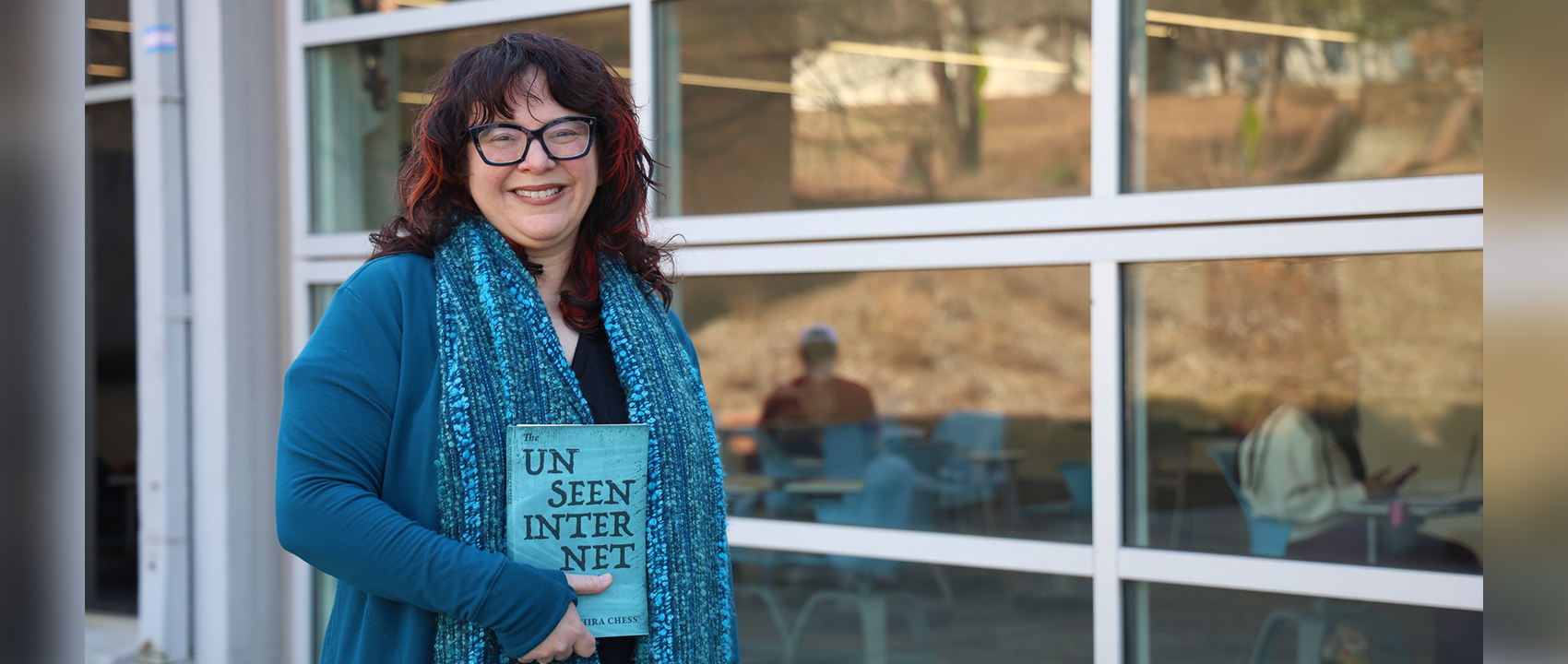
Shira Chess authors book about evolution of internet and belief systems
An examination of the rise of the internet and its connection to belief systems is the subject of “The Unseen Internet,” a new media studies book by Shira Chess, associate professor in the Department of Entertainment and Media Studies at Grady College.
“We have a reliance on science and technology, but we’re so removed from it at this point that is might as well be magic,” Chess explained. “I’ve spent a lot of time thinking about how the internet has disrupted how we understand reality, and there is an esoteric core to that.”
Chess explains that the book discusses a lot of fringe beliefs and examines how people can understand these beliefs in context of when the internet was born.
Chess, who enjoys linking ideas, begins the book with a discussion of the hippie counterculture and how it transitioned on the West Coast to ultimately become Silicon Valley.
“There was a disproportionate number of people on the early internet and defining digital culture both from the industrial side and also the cultural side that had non-traditional spiritual beliefs,” Chess explains.
One of the beliefs Chess researched for the book is Simulation Theory, a philosophy that has been forwarded by Elon Musk where believers think everyone is living in a computer simulation. This is also a concept explored in the movie “The Matrix,” with the idea that the world is an illusion.
“I pull this thread forward in my book and talk about how ‘The Matrix,’ affected our perceptions of the 21st century in a multitude of ways,” Chess says.
Chess, who was looking for ways to transition from her studies of digital games and apps, evolved the idea for the book during a recent research fellowship. She began by considering the uncanny nature of the internet, and the project grew from there. She is the author of two other books: “Play Like a Feminist” and “Ready Player Two.”
Other topics covered in the book include a chapter of reality shifting, wherein some young people had in the early 2020s believed that they were able to transport their souls into a different reality to create a different version of themselves. Chess also talks about AI and how the way tech professionals in Silicon Valley talk about AI as different incorporeal, or abstract, entities such as the Loab hallucinations from 2022.
“We, as a society, have innovated in incredible ways with our digital and internet technologies, but with those innovations we are facing down a mountain of new problems,” says Chess of the reason she wrote the book. “I think the only way that we can fix any of it is by looking back at those flashpoint moments when those technologies were first being built: revisiting our beliefs, our rituals, and our choices.”
Chess is already working on her next book: a study of the cyberculture magazine Mondo 2000, due to be published in 2027.
Author: Sarah Freeman, freemans@uga.edu