

Maggie Liao investigates trust in news gathering sources
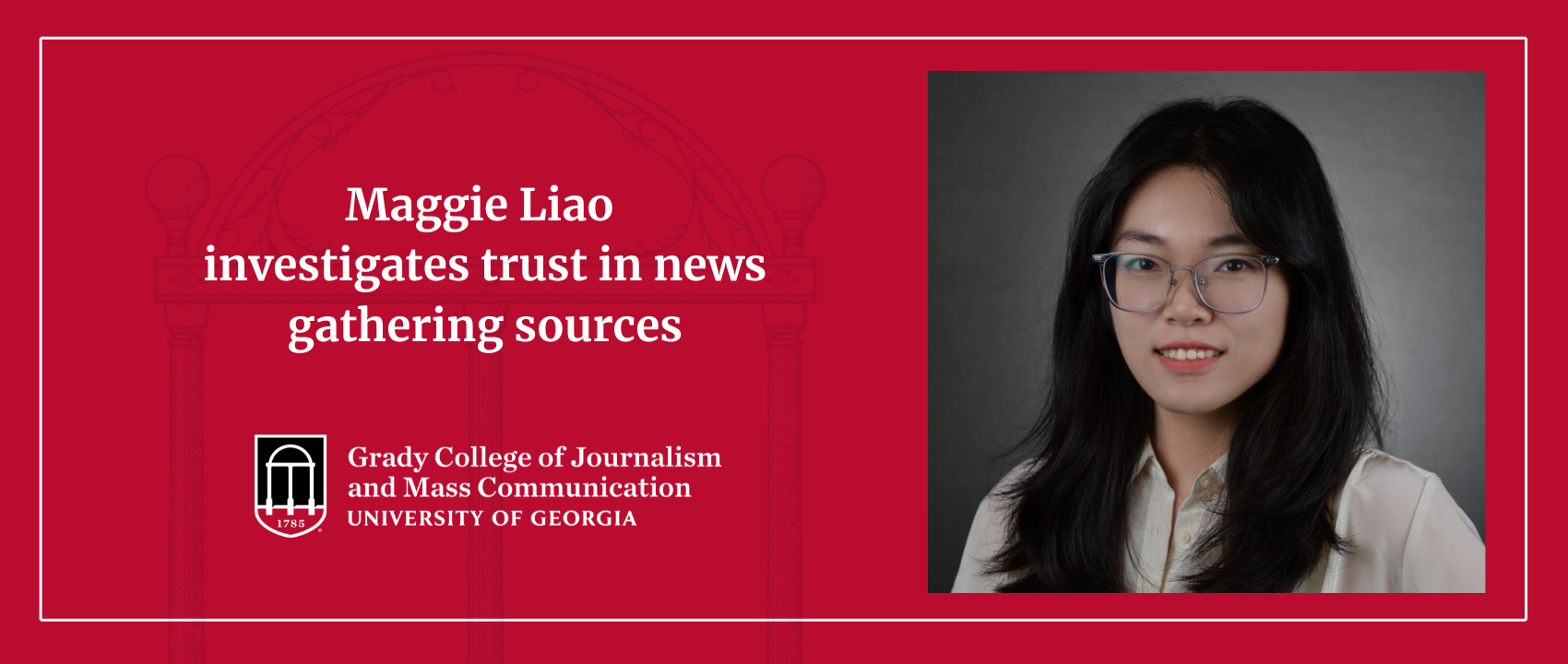
Maggie Liao investigates trust in news gathering sources
Social media has offered users more ways to stay informed on topics local to global than ever before, facilitating massive networks of worldwide communication.
Online users, however, are often overloaded with information. The are constantly exposed to large amounts of news feeds across various devices, making the source of that information an important factor they rely on when deciding what to trust, according to a new research study from Mengqi (Maggie) Liao, an assistant professor in the Department of Advertising and Public Relations (AdPR) at Grady College.
The growing volume of available information and the constant flow of news through social media algorithms have led to the “News Finds Me” (NFM) perception. NFM is a belief that individuals can stay informed about current affairs without actively seeking out information, believing that their online social networks will keep them informed.
“If you’re just relying on social media friends or AI, you just get a really small facet of what is going on out there because everything is so personalized,” Liao said.
Liao studies the psychological effects of communication technology and has most recently focused on AI. Her research seeks to answer when people trust technology, the psychological mechanism behind this trust and how we can help people better calibrate their trust towards technology.
In her newest research article, “When We Think ‘News Will Find Me’: Relative Credibility of Social-Media Friends, Algorithms and Editors,” Liao and her co-authors designed an experiment with respondents of different NFM levels to receive news from their social media friends, news editors or an algorithm to evaluate their level of trust in these sources.
The Design
The experiment included 244 usable respondents with a range of different NFM levels. They were then randomly assigned to interact with a mockup of a news recommendation system called the Daily Times, which recommended news stories selected by either news editors, social media friends or an algorithm.
After they were sorted, respondents were directed to a landing page that explained the news aggregation system and asked them to build a profile. The social media group was asked to log in to their social media accounts so the system could see their online friends. The algorithm group was asked to log in to their web browsers to get access to their news consumption behavior to give an illusion that the system is learning about users’ social media ecosystems or news consumption behaviors. The respondents assigned to the news editor group were not asked to log into anything.
All groups were then directed to a landing page where they could interact with six top news stories that, they were told, were curated by either news editors, social media friends or an algorithm. The website was designed to track their interactions, including how long the participant stayed on the landing page, what they interacted with and the first actions they took. Participants were also asked to report their evaluation of this news recommendation system.
The Results
Previous literature showed that people who are high in NFM are receptive to information, but they are not likely to seek it out themselves. They tend to put more faith in their social media algorithms and friends to find news for them. This study revealed that it is because news consumers high in NFM consider their social media friends and algorithms to have the same authority on the news as reporters and news editors, known as “authority heuristic,” a finding that surprised Liao.
“We originally were thinking because you feel your social media friends are like you… that’s why you trust it,” Liao said. “We were thinking there must be some reasons why they trust their social media friends and AI more, but we were not expecting… that they think they are the authority in journalism practices.”
Liao was, however, relieved to find people still trust news editors in general. Those who tested low in NFM perception were more likely to trust news editors and gatekeepers to accurately collect and report the news.
“A lot of people are criticizing journalists and journalism practices, but I wouldn’t call it surprising,” she said. “People who are low in NFM don’t develop this mindset. Naturally, we think news editors are the authority.”
This study also found that online news consumers are increasingly putting more faith in their social media algorithms, because of the triggering of “machine heuristic.” The machine heuristic is a cognitive shortcut humans use in which they assume machines, such as AI chatbots or recommendation algorithms, are more accurate, objective and bias-free than humans, according to Liao’s article.
This may be especially true in the era of AI-powered search. Liao knows plenty of people who, instead of suggesting to “Google it,” rely on AI to bring information and news to them. She believes letting chatbots aggregate news could pacify high-NFM individuals further, decrease current events knowledge and introduce the risk of spreading misinformation.
“If they want to seek out information… they don’t even Google search anymore,” she said. “They just turn on AI and then ask for that information, and then we all know that Gen AI can hallucinate.”
How Can News Organizations Adapt?
The overreliance on social media friends and algorithms, Liao believes, is a problem for news publications to solve.
Liao hopes that media researchers, journalists and editors will find value in the paper’s findings to create solutions that improve their reporting and encourage readers to actively follow news.
“We hope they draw some practical implications from our findings that can make their journalistic practices better and inform the news audiences,” she said. “Sometimes it is our job to communicate this to them and educate them.”
Ultimately, Liao recommends that those who are high in NFM should work to find more news for themselves.
“Our general takeaway is that you probably need to change your mindset, and then actively seek out information yourself.”
Author: Sam Tupper, samuel.tupper@uga.edu